Starmer Is In Tune With Voters Over Iran
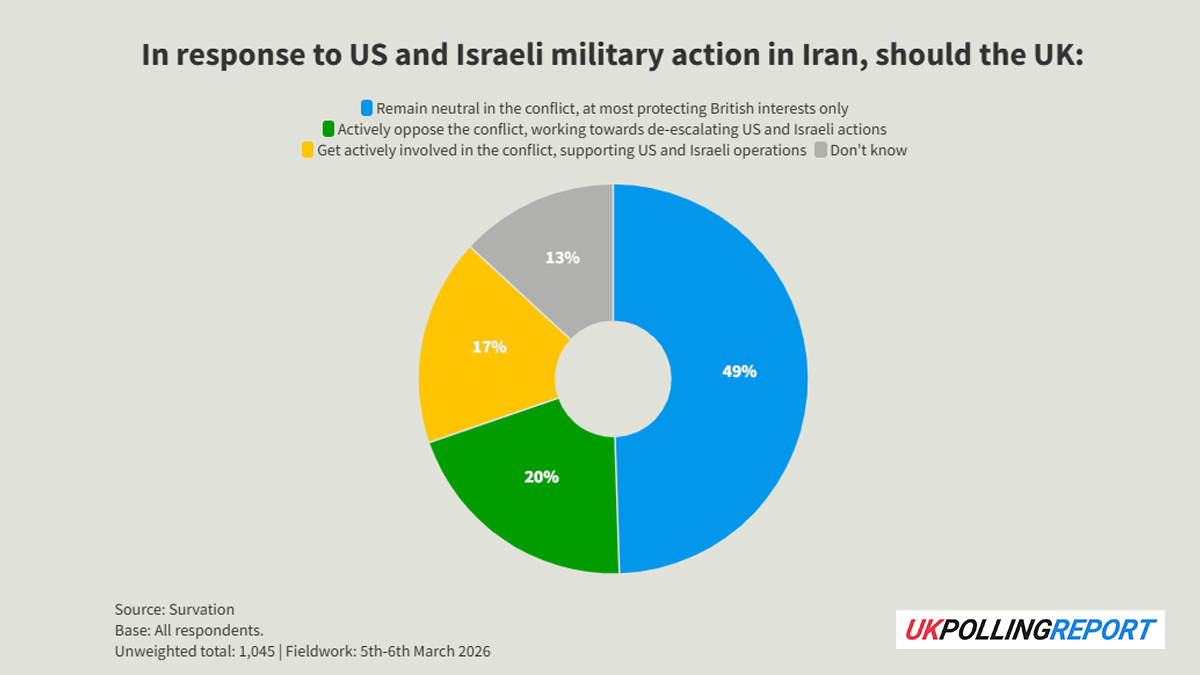
Since the first strikes were launched by the US and Israel on Iran, public scepticism and reluctance towards the UK’s involvement in the war has grown steadily. In recent polling by Survation, nearly half of respondents (49%) want to remain neutral with a focus on protecting British interests. A fifth (20%) strongly oppose the conflict, while only 17% support Britain’s active involvement in the conflict.
Given the long build-up up to the war and the war’s implications on energy costs and trade, this issue has captured the public’s attention. Survation found that on a 0–10 scale measuring concern 20% of respondents had selected the highest rating of 10, with the modal answer being an eight. This suggests that this conflict is at the forefront of the public's consciousness.
However, voters are divided on whether or not Keir Starmer is managing Britain's position on Iran effectively. A YouGov poll, shows that 41% of voters believed the Prime Minister has responded badly to the US’s actions against Tehran, versus 37% who believed he has responded well.
In response to the US-Israeli strikes, Iran has severely curtailed shipments through the Strait of Hormuz, one of the world's most critical trade routes. This development carries serious implications on energy prices worldwide. On Monday, Starmer announced £53 million for the most economically disadvantaged households for heating oil allowances. This action to reduce energy prices for households has been widely welcomed with 84% of voters approving according to YouGov rising to 88% approval from Reform voters.
Furthermore, regarding politicians' responses to the Iran Conflict, Keir Starmer comes out on top with 33% supporting his response and 32% opposing it, according to Survation. Kemi Badenoch and Nigel Farage both receive 28% in support, although Farage faces higher opposition. Ed Davey and Zach Polanski face lower levels of support and higher proportions of respondents being neutral or "neither support nor oppose”. While interest in the conflict appears to be high, public opinion on politicians' responses is divided. A significant proportion of the public is neutral or unable to form an opinion due to a lack of information on politician’s stances.
Overall Starmer's position is being better received by voters, in particular his domestic response with fuel allowances. Although broader perspectives on UK foreign policy to Iran conflict remain sceptical.