What Would Happen If the Prime Minister Lost Their Seat?
Britain’s unwritten constitution assumes the incumbent Prime Minister gets the first chance to form a government. But what happens if that Prime Minister has been personally ejected by voters in their constituency?
Britain’s unwritten constitution assumes the incumbent Prime Minister gets the first chance to form a government. But what happens if that Prime Minister has been personally ejected by voters in their constituency?
Polling day in England’s local elections arrives amid a growing sense of dread inside Labour. The expectation in Westminster is no longer simply that the governing party will lose support between general elections. It is that the political system itself has become unstable in ways Britain’s constitutional conventions were never really designed to handle.
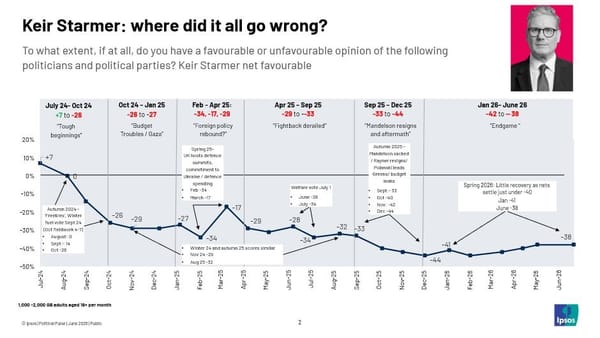
Much of the immediate conversation has focused on the usual Westminster gossip: whether Keir Starmer’s leadership will come under pressure after poor results; which cabinet figures might emerge as contenders; and whether Reform’s rise represents a temporary protest or a more permanent feature in British politics.
But beneath all of that sits a larger and much less discussed problem.
Britain may be heading towards an era in which coalition politics, fragmented electoral geography and increasingly vulnerable leadership seats collide at the same time. And that raises a constitutional question Westminster has never really had to answer before:
What happens if a sitting Prime Minister loses their own parliamentary seat during a general election?
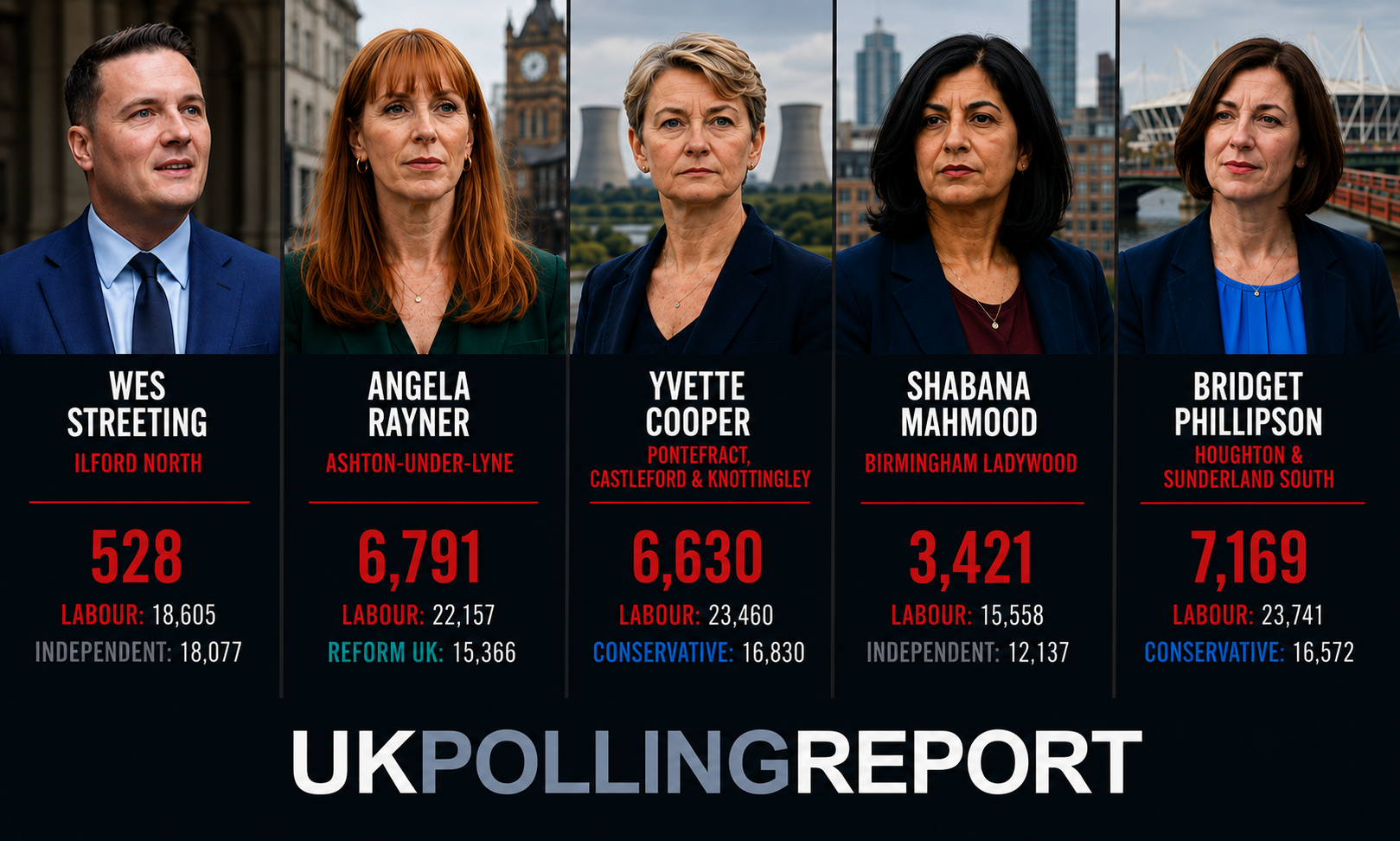
Under current polling trends, that scenario is no longer impossible. Senior politicians who would once have expected comfortable majorities are now sitting in constituencies vulnerable to dramatic swings, multi-party fragmentation and asymmetric Reform surges. Several Labour who are discussed as potential future leaders hold seats that are looking unexpectedly fragile.
Historically, Britain’s governing class has been insulated from this kind of danger. Prime Ministers and leadership contenders were expected to occupy safe seats. Governments rose and fell nationally, but the political elite themselves usually remained personally secure.
There has long been an implicit assumption in Westminster politics that party leaders benefit from a kind of electoral protection. Leadership brings visibility, prestige and local organisational strength. Prime Ministers and leadership contenders were expected not merely to survive elections, but to do so comfortably.
Recent international examples suggest that assumption may be weakening. In both Canada and Australia last year, major party leaders lost their parliamentary seats despite their national prominence. Fragmented electorates, anti-incumbent sentiment and increasingly personalised political anger may be turning leadership into an electoral vulnerability rather than a safeguard.
If that pattern spreads to Britain, constitutional conventions built around politically secure leaders may begin to look a little shaky.
The British constitution operates on a convention that is not widely understood by the public. After an election, the largest party does not automatically get the first opportunity to form a government. Instead, the incumbent Prime Minister remains in office until it becomes clear that they cannot command the confidence of the House of Commons.
That convention was visible in both February 1974 and 2010. Edward Heath remained Prime Minister while attempting to negotiate an arrangement with the Liberals after Labour emerged as the largest party in 1974. Gordon Brown remained in Downing Street for several days after the 2010 election while coalition discussions took place between Conservatives and Liberal Democrats.
The logic behind the convention is simple. The monarch is not supposed to make political decisions. The system therefore prefers continuity. The incumbent Prime Minister remains in place while political negotiations establish whether a viable government can be formed.
In a two-party system, this arrangement is usually straightforward enough. But Britain is no longer a two-party system.
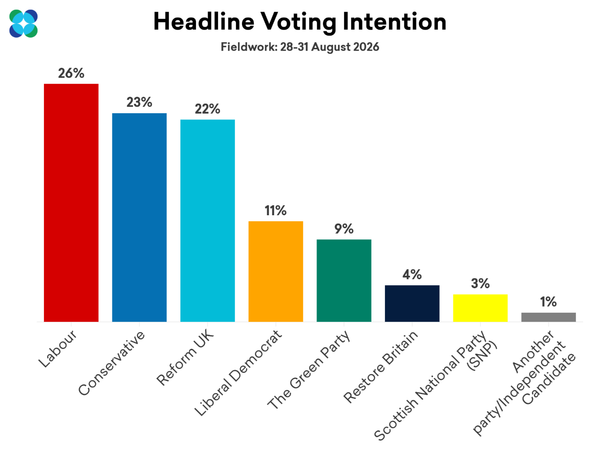
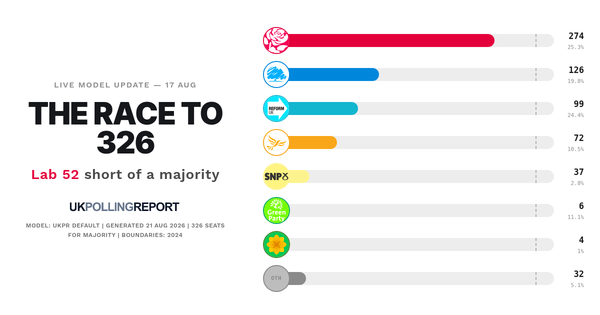
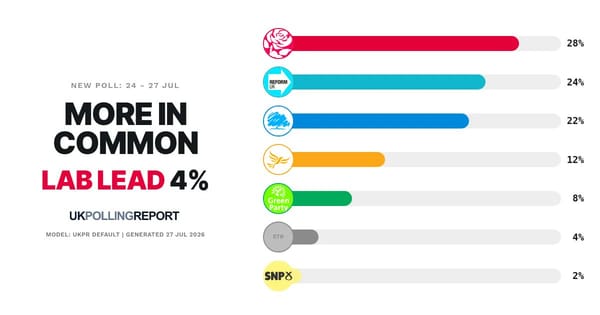
Current polling suggests a highly fragmented parliament after the next General Election. A Reform-Conservative arrangement is one conceivable outcome. So too is some form of anti-Reform "rainbow" coalition involving Labour, the Liberal Democrats, Greens and nationalist parties. Neither possibility looks implausible anymore.
And that is where the constitutional tension begins.
Imagine a scenario in which Labour loses substantial ground nationally but still retains a potential coalition path to government. Imagine further that the sitting Labour Prime Minister loses their own seat. Meanwhile Reform emerges as the largest single party in Parliament, albeit without a majority.
Who gets the first opportunity to negotiate?
Technically, the answer is still the incumbent Prime Minister.
There is no legal requirement for a Prime Minister to sit in the House of Commons. Historically, Prime Ministers have governed from the House of Lords, and Alec Douglas-Home briefly governed from outside Parliament altogether in 1963 while arranging his election to the Commons through a by-election.
Constitutionally, therefore, a defeated Prime Minister could theoretically remain in office temporarily while coalition negotiations continued and a route back into Parliament was organised.
But constitutionally possible and politically digestible are not necessarily the same thing.
A Prime Minister personally rejected by voters, leading a party that may not even be the second largest in Parliament, attempting to negotiate a coalition government while awaiting a manufactured by-election would place extraordinary strain on the legitimacy of the system.
Could they negotiate on behalf of a government they themselves could no longer realistically lead? Would coalition partners tolerate it? Would markets? Would the public?
And perhaps most importantly, would the country accept a situation in which the largest party were denied office by an incumbent Prime Minister who had personally lost their seat?
None of these questions has an entirely clear answer because Britain’s constitution depends less on codified rules than on political restraint, public legitimacy and shared assumptions about acceptable behaviour.
That ambiguity is usually a strength. It allows flexibility during crises and avoids rigid constitutional deadlocks. But it also assumes that political actors broadly accept the legitimacy of the conventions themselves.
That assumption may become harder to sustain in an era of populist politics, social media outrage and fragmented electoral mandates.
The monarchy, too, would be placed in an extraordinarily delicate position. Modern constitutional practice works very hard to avoid involving the sovereign in political choices. The entire point of the incumbency convention is to prevent the monarch from appearing to select governments personally.
But a fragmented parliament combined with a defeated Prime Minister could create precisely the kind of ambiguity the system is designed to avoid. Not because the King would actively choose a government, but because the lack of a clear democratic outcome would inevitably draw attention towards the Crown’s residual constitutional role.
And all of this becomes more plausible as British politics becomes more geographically volatile.
The deeper issue is not Wes Streeting, or Keir Starmer, or any individual politician. It is that Britain’s constitutional conventions were built for an age in which election winners and losers were usually obvious. Governments alternated between two dominant parties. Leadership seats were safe. Parliamentary majorities were relatively stable.
Britain is now in a different era altogether.
An era in which governments survive through fragile coalitions. In which leadership speculation becomes permanent. In which senior ministers increasingly sit in vulnerable seats. And in which the gap between constitutional theory and democratic legitimacy becomes harder to ignore.
The Westminster system has survived for centuries largely because it has avoided being forced to answer certain questions directly. A Prime Minister losing both an election and their own seat, while still attempting to negotiate a path back into office, might finally force it to do so.
In the meantime, MPs plotting their leaders' defenestration have another facet to consider in their games of 5D chess. And you have to assume that Buckingham Palace have their fingers crossed in the hope of an unexpectedly decisive election outcome.