YouGov/Sunday Times - CON 32, LAB 43, LD 12, UKIP 9
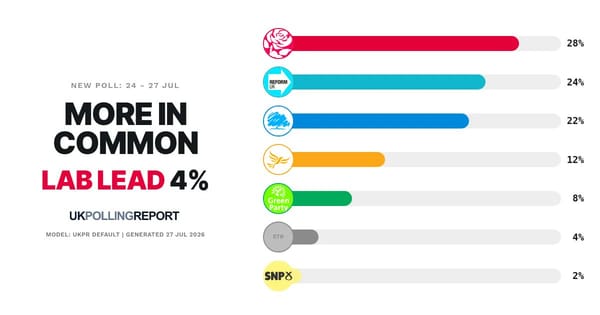
This week's results for the YouGov/Sunday Times poll are online here. Topline voting intention stands at CON 32%, LAB 43%, LDEM 12%, UKIP 9% - so very much in line with the typical YouGov Labour lead of about 10 points. There's no sign of any remaining effect from the EU referendum pledge here.
Horsemeat
Almost three quarters of people blame food manufacturers (26%) or meat processors (46%) the most for the horsemeat scandal, rather than retailers (11%) or the government (6%). While a majority of people think that there is more the government could be doing to keep the food chain secure, broadly speaking the government is seen to have handled the horsemeat scandal well - 47% say they have handled it well, 39% badly.
68% of people do not think there is any actual health risk from horsemeat getting into the food chain and 37% say that, if it was properly sourced, they would be prepared to eat horsemeat.
Relatively few people say that they will substantially change their behaviour as a result of the horsemeat
scandal - only 5% say they might change which supermarket they use to they buy their groceries, only 13% that they will reduce the amount of meat or beef that they will buy. However, a third of people say that they will reduce the amount of *processed* meat they will buy. In reality all these are likely to be gross overestimates: it is much easier to say in a survey that you will change your behaviour than it is to do so in real life - in practice most people will probably continue as usual.
Eastern European Immigration
On the general principle of the freedom to work and live anywhere within the European Union, 33% of people think it is a good thing, 56% a bad thing.
On balance immigration from western European countries like France and Germany is seen as a positive thing (39% think it has had a positive effect on Britain, 16% a negative effect, 31% neither). Immigration from Eastern Europe and from outside the European Union are both seen as having had a negative effect on Britain by a majority of respondents.
70% of people think that the rules on immigration into Britain from the EU should be tougher, almost the same as the 73% who think the rules on immigration into Britain from outside the EU should be tougher. On the specifics of the extension of the right to live and work across the EU to Bulgarian and Romanian citizens, 20% of people think there is no problem with this and Britain should welcome them, 19% think it will have a negative impact on Britain but we have no choice but to meet our legal obligations, 48% think Britain should limit the right of Bulgarian and Romanian citizens to live and work in Britain, even if it means breaking the law.
Foxes
There is little support for fox hunting being legalised. Only 23% want to see the ban lifted, compared to 65% who would like it to remain. This includes 50% of Conservative voters.
29% of people who describe the area they live in as "urban" say the number of foxes in their local area has increased in recent years, but the overwhelming majority, 92%, say that they have never been attacked or felt threatened by a fox. Nevertheless there is significant minority support for a cull of urban foxes - 38% would support a cull, but 41% would oppose it.
Long term care and inheritance tax
52% of people say they support the government's plans on capping the cost of long term with only 21% opposed. 50% of people say that it is right that the plans to reduce inheritance tax were shelved to fund the long term plans, 26% would rather they had been funded in some other way.
Asked a straight choice of whether they'd prefer inheritance tax to be reduced, or the cost of long term care to be reduced, far more people choose the later - 57% to 18%. This is particularly the case for older voters, people over the age of 60 say they would prefer a cut to long term care costs over a reduction in inheritance tax by 66% to 13%
Workfare
Finally, 76% of people support the principle of withdrawing benefits from unemployed people who refuse to work. On the more specific recent court case, 55% of people think the government should be able to withdraw benefits from unemployed people who refuse to do unpaid work experience, 34% think they should not.