YouGov/Sunday Times - CON 31, LAB 42, LD 9, UKIP 13
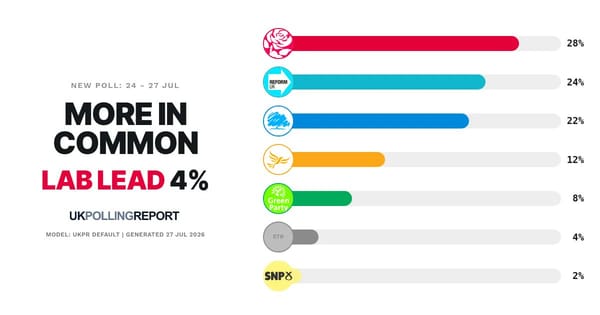
YouGov's weekly results for the Sunday Times are out here and show Labour continuing to enjoy a boost from their conference. Topline voting intention figures are CON 31%, LAB 42%, LDEM 9%, UKIP 13%, the first double-digit Labour lead this month. Ed Miliband's own ratings are also up - 30% now think he is doing a good job as Labour lead, up from 22% last week. In YouGov's polls at least there appears to be a real change from Labour's conference - what remains to be seen is whether it lasts, or is rapidly cancelled out by the Conservative conference next week.
For now though let's look at the post-Labour party conference polling. 50% think it is true to say that Miliband has moved his party to the left, but they are divided over whether this is a good or bad thing - 23% see it as a positive, 27% see it as a negative. More empirically (since people aren't very good at comparing their views now to their views in the past), YouGov asked people to place the parties on a left-right scale, from very left wing to very right wing. 34% now see Labour as very or fairly left wing, up from 26% last year and the highest since YouGov started asking this question back in 2006 (under Blair and Brown it tended to be around 20%). Note however that the Conservatives are seen as very or fairly right wing by 39%, so Labour may been seen as having moved more to the left, but it does NOT mean they are seen as less centrist than the Conservatives are.
Looking at some of the specific policies Labour promised at their conference, 63% support the energy price freeze, but the most widely supported policies were actually increasing the minimum wage (71%) and increasing corporation tax for big companies and cutting rates for small firms (71%). There was majority support for seizing land from developers who don't use it (53%) and making firms offer an apprenticeship for each immigrant they employ (52%). The only major announcement from the conference that people did not support was giving the vote to 16 year olds, opposed by 61%.
Looking more specifically at the energy promise, while people support the principle of it, there are some doubts about whether it would actually work. Asked it if would actually deliver better value and no big prices rises for ordinary people 42% think it likely would, 47% that it's unlikely it would. While only 27% of people thought it likely there would be power cuts and shortages because of a price freeze, 58% thought it was likely that it would lead to less investment in renewable and green energy. 53% did think it would likely reduce the profits of the energy firms (while the poll made no judgements as to whether that was a positive or negative outcome, I suspect many respondents would have seen it as a plus!)
Another worry for Labour is while people support the policy announcements, there seems some doubt about whether they are actually affordable - 52% think Labour are making promises the country can't afford, 23% disagree. To put that in context only 35% think the Conservatives are making unaffordable promises, 36% do not (though who knows what they'll announce in the week ahead that might change that).