YouGov Immigration Poll Highlights Political Salience of Channel Crossings
YouGov have recently produced some research into public attitudes on immigration. Its findings raise a number of conflicting issues, though can broadly be summarised by broad dissatisfaction over the Government's handling of immigration, with more support for a restrictionist policy than for a liberalised one. Looking closer at the results can give more specific insights into both polling design and party strategy on immigration.
First of all, the survey can act as a useful case study in research design. In particular from the question:
"For each of the following groups of people, please indicate if, generally speaking, you have a positive or negative view of them?... Refugees crossing the English channel to get to the UK"
The results from this are interesting, if somewhat surprising. 55% of respondents held a negative view, compared to just 19% with a positive one. The net negative held even amongst 2019 Liberal Democrats and Remain voters. This tells us that the British public generally disapprove of irregular crossing of the channel to use a neutral phrase. Where the difficulty comes is in broadening the appeal of this conclusion - you couldn't, for example, infer from this that the British public disapprove of the number of refugees generally.
It certainly seems intuitive that were the question reframed as "Refugees fleeing war", responses would be more positive. Both descriptors could be equally true, yet by focusing on one the polling can suggest a different conclusion. It is for this reason precision is key in reporting on polling.
The next question, which gathers perceptions on "Migrants coming to the UK looking for work", raises similarly intriguing implications of wording. It sees a net positive response of 9%. Considering much public discourse centres on discouraging "economic migrants", the fact the public favours this group over refugees, even those crossing the channel, is at least somewhat counter-intuitive.
These surface-level contradictions could provide insight into the motivation of voters. The evidence suggests British public disapprove of channel crossings. Whilst the importance of the "looking for work" proviso hints at a perception that there are some, less-favoured, work-shy migrants.
There is further evidence of the importance of Channel crossings to Brits' understanding of migration. Of those who disapproved of government immigration policy, 52% attributed it to "failure to stop migrants in the Channel". A response rate greater than any other reason. The fact immigration is rising in salience, and that it is even more important to Conservative voters, will no doubt be weighing on the mind of Rishi Sunak.
Though he perhaps has less at stake than Keir Starmer. Even with 87% of the public responding the government was handling immigration badly, earlier polling suggested the Labour Party still lags the Conservatives on the issue.
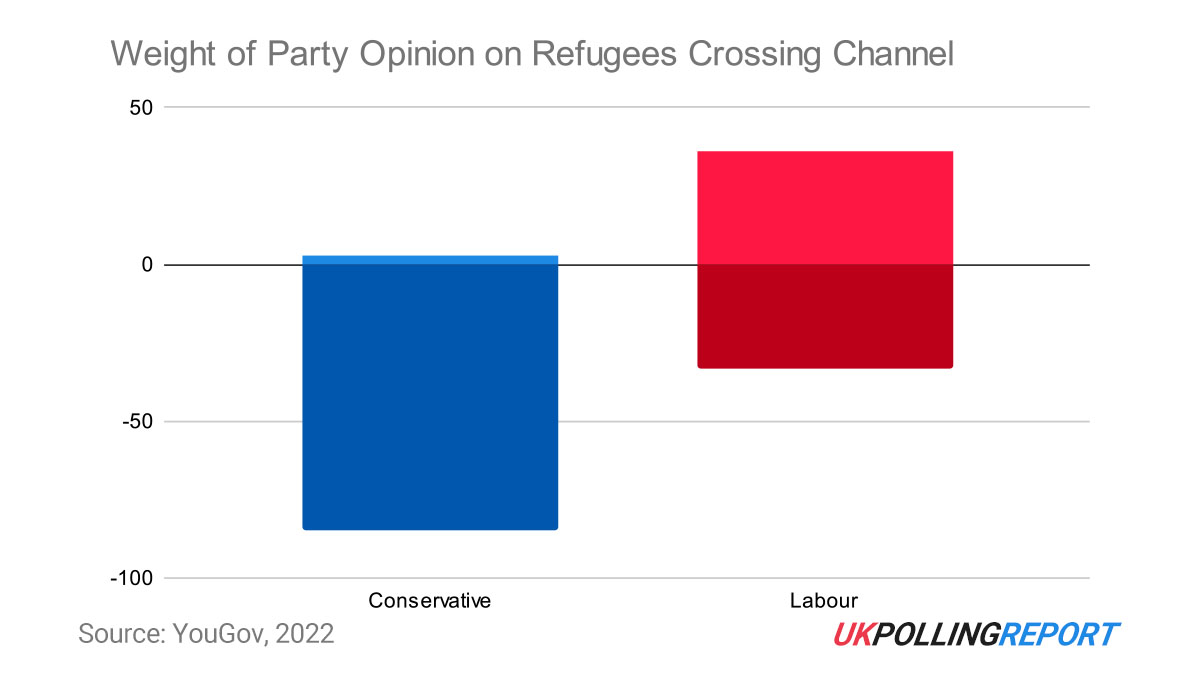
Attempting to regain credibility on immigration also presents Labour an immense challenge, as they may have to seek a broader appeal on social issues. The below chart shows responses to the question first highlighted, broken down by 2019 party. Positive respondents are denoted with positive values, and vice versa. It illustrates that on attitudes towards refugees making channel crossings, Labour's voter base is more divided.
If they are to reach out to those lost in 2019, they may want to take a tougher line. Yet this risks isolating their urban core. The fact older voters, often more socially authoritarian and Conservative voting, can be more relied upon come election day also puts the Conservatives in a stronger position. They can afford to lean in to their base, whilst Labour have more incentive to reach out. In doing so, Keir Starmer may well face a difficult balancing act.