Rishi Bounce is Over - What's Next for the Conservatives?
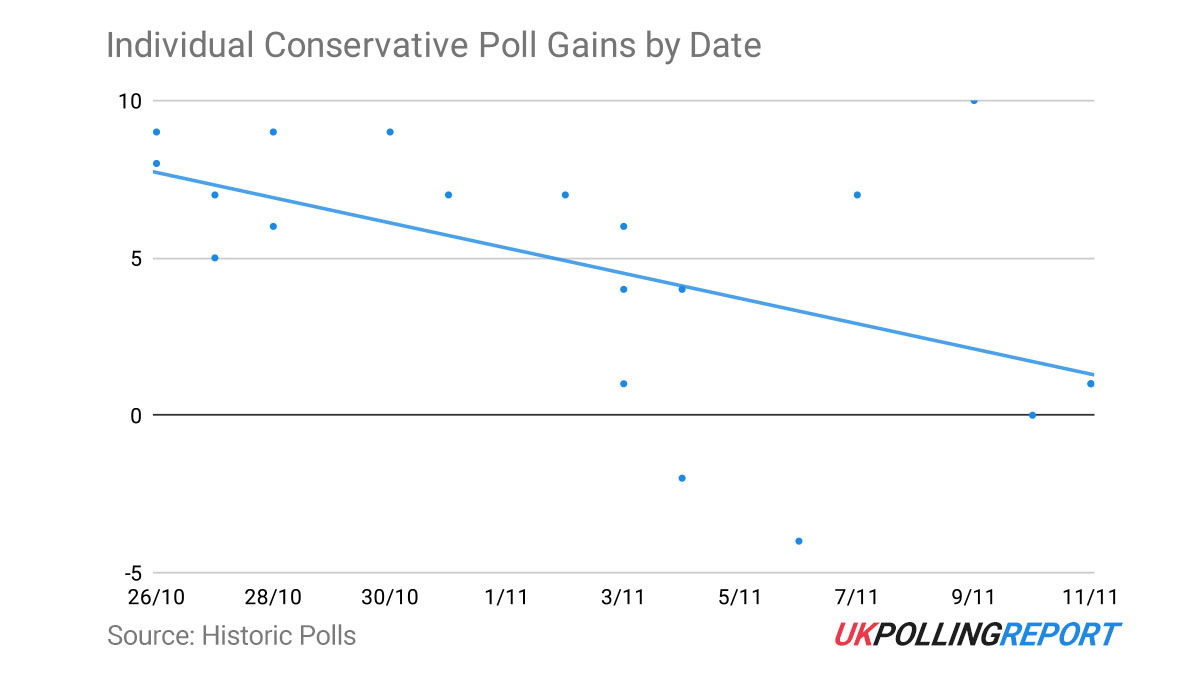
As Rishi Sunak settles in to his new job, British public opinion has subsumed the system shock of a new Prime Minister. The polls did initially close, though there is now a more settled picture as Labour see consistent leads at around 20%. This is demonstrated by the below graph, which charts individual polling gains by the Conservatives over the past few weeks. The trend line indicates that the "Rishi Bounce" appears to be over.
Whilst there have been some outliers, these can be explained. (The result from November 9 was from People Polling, and can be discounted because the gain it was registered on was from an older poll.) The overall result was a Labour lead of 21%, in keeping with the broader polling picture. Similarly the polls which show Labour extending their lead could be explained by variance within margins for error. For the moment, the picture is clear.
Labour will be delighted with this. Their lead is larger than at any point under the premiership of Boris Johnson and this is after Rishi's personal popularity has filtered through. To make matters worse for the Conservatives, economic issues and the cost of living are consistently ranked as the most pressing of voters' concerns. It seems difficult to imagine the government will make up ground in these areas under the conditions of contractionary economic policy in a period of recession.
The Conservatives will want to avoid giving the opposition any major ammunition, as Liz Truss did with the planned cut to the 45p tax rate. They may also want to try to set the agenda. Trying to focus on areas such as immigration, crime and foreign policy, where the Conservatives are trusted more, may help. Though with such a large deficit tinkering around the edges is unlikely to be sufficient for the party to avoid a large defeat.
The polling suggests a need for a more radical shift, whether through an exogenous shock or some theoretically, nearly impossibly, bold yet feasible strategy. Out of the 5 most recent polls, an average of 21% of 2019 Conservative voters switched alliances to Labour. This marks a significant increase, especially from polling taken before Truss took office.
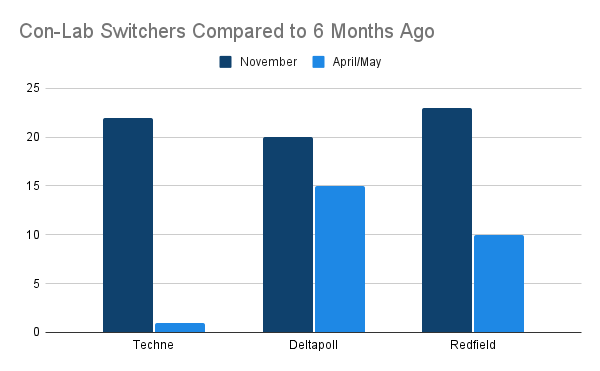
The above chart demonstrates this by comparing the figures for three specific pollsters between recent polling and from 6 months ago. For reference, even under the more favourable figures, the Conservatives lagged Labour by 10%.
The Conservatives have lost voters, not just to indifference, but active opposition. The fact these voters remain opposed, even after the effects of a new leader seem to have filtered through, suggests the Conservatives' main challenge to regaining standing in the polls has not been changed by a new Leader. It seems difficult to imagine a path back for the Conservatives.