Support for Strikes Increases as Public Still Split
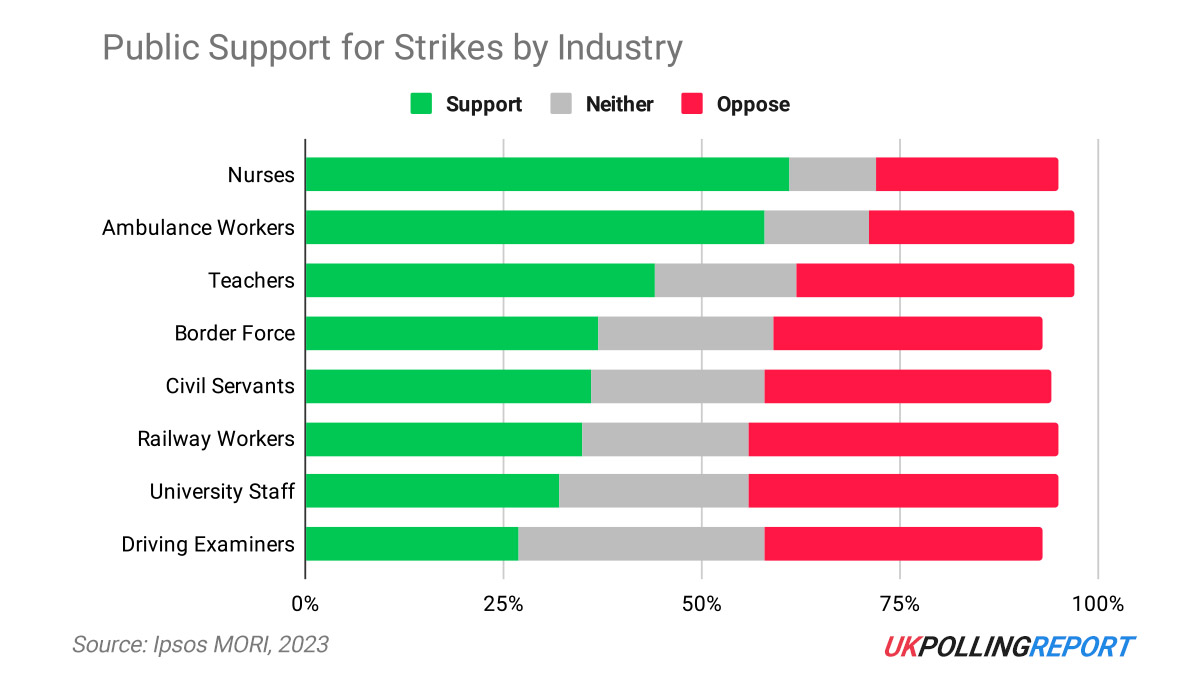
As "Walk-out Wednesday" - where half a million workers are walking out in co-ordinated strikes - gets underway, Ipsos MORI have looked at opinion towards the action. It reiterates that the public is broadly split, with similarly sized blocs both in favour of and opposed to strikers. As the public, by a margin of 40% to 10%, thinks co-ordinated efforts are more effective than individual unions striking.
Support for strikes is heavily dependent on striking industries, with the public most sympathetic to nurses and least towards driving examiners.
The data suggests civil servants are the main winners from the past month. When Ipsos asked the same question in December, the public opposed strike action. Now, opinion is split down the middle.
These figures can be contextualised with data from The Times, which has tracked real terms pay by industry. The relative support for teachers and nurses could be influenced by the fact they are being underpaid relative to both private and public sectors. Meanwhile, railway workers' above average pay perhaps explains why they come off somewhat unfavourably. University staff are the one group bucking the trend. Despite declining pay - even relative to the public sector - the public is yet to get behind them.
On the strike action of the day, there is a slim margin in support of co-ordinated action. 40% support today's strikes, as a similarly sized 38% is opposed. This does mark an increase in support relative to similar questions asked previously. Back in December, Ipsos found -6% net support for rail strikes. This shift is perhaps explained by the above graph - railway workers experience somewhat less sympathy than others - and the fact action was planned over the Christmas period.
In news that is broadly in line with personal approvals, the public doesn't back Rishi to manage the strikes. 51% say Rishi Sunak's government is doing a bad job. Whilst, by a slim margin (31% to 23%), voters say a hypothetical government lead by Starmer would do better. Unsurprisingly, support for strikes remains strongly correlated to both age and party support.