Sturgeon's Supreme Court Setback Isn't All Bad for SNP
The Supreme Court yesterday dealt Nicola Sturgeon's plans for a second independence referendum a significant blow by denying a right to indyref2 without Westminster consent. There are a number of reasons why the First Minister may not be so disappointed with the verdict.
Firstly, despite her public plans, a referendum in the short-term might not be the most advantageous for the SNP. The medium-term polling on support for independence has, over the past year, tended to put "No" ahead. This is far from the consistent support seen for independence over the course of the pandemic.
If Sturgeon were to lose another referendum, the case for independence would certainly be hampered and, whilst she may see it as a worthwhile risk, holding off for now may be advantageous. Especially when young voters are disproportionately likely to support independence.
Moreover, the court decision itself could lend strength to SNP arguments. The fact that the Scottish Parliament is so visibly being subordinate to Westminster lends strength to a core argument of the "Yes" campaign. This fact is reflected in Sturgeon's public comments since the ruling, arguing the SNP was launching a "defence of Scottish democracy".
This also helps brings Sturgeon's stated plan for the forthcoming General Election to serve as a 'de-facto' border poll closer to fruition. If Sturgeon can maintain the salience of independence, she may well be able to benefit electorally. The SNP has long capitalised on the fact independence supporters are concentrated within the party whilst the unionist vote is split. Keeping it this way could see her party maintain a strong electoral performance, even after 15 years in power in Scotland.
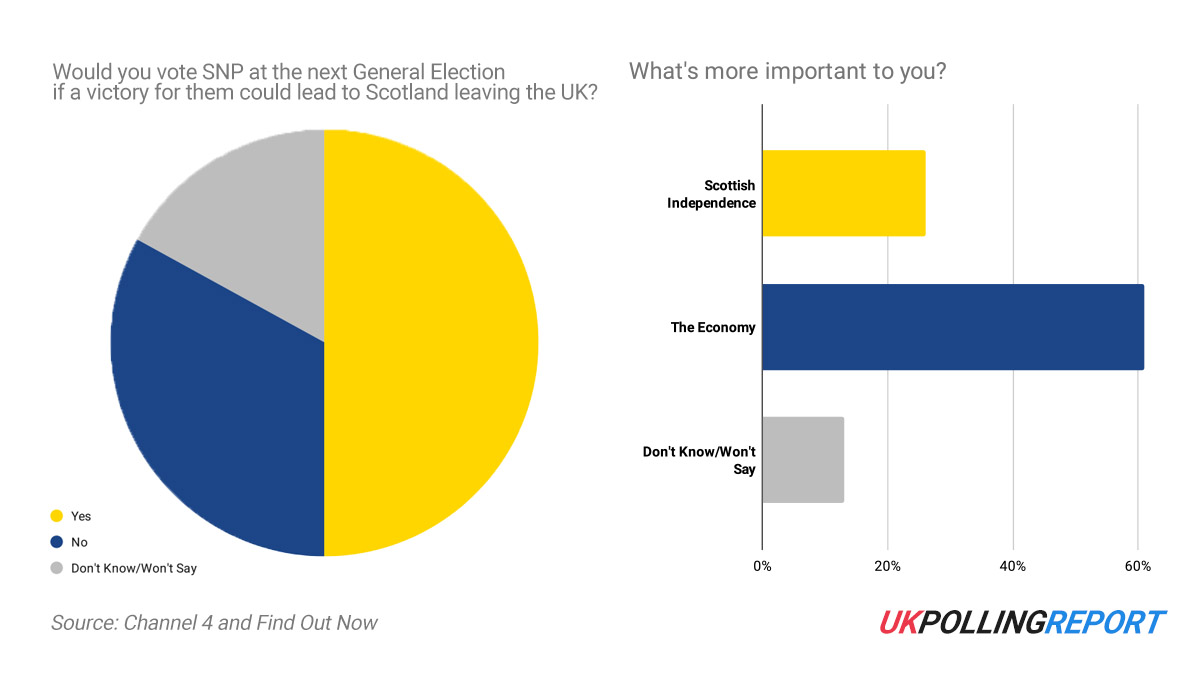
The promise of this strategy was borne out in snap polling from Channel 4 and FindOutNow. The pollster asked:
"Would you vote SNP at the next General Election if a victory for them could lead to Scotland leaving the UK?"
and found 50% responding affirmatively. Whilst this is a strong result for the SNP, it is worth questioning the wording itself. The question is a hypothetical, based on a fairly strong conditional. It is near impossible to know whether an SNP victory could lead to independence, and voters themselves might not be able to predict how they would react even under those circumstances. So the value of the question is somewhat limited. Moreover, by focusing on just one party and issue it may well advantage the SNP's tally, perhaps at the expense of independence supporting Greens or Alba. Despite these shortcomings, the results do show the potential of a strategy to unite independence voters behind the SNP.
Though another question in the poll also highlights such a strategy's challenges. When asked what was more important of Independence or the economy, 61% opted for the economy. Compared to 26% saying independence. So whilst a 'de-facto' referendum might benefit Sturgeon, it won't be easy to bring about when the cost of living is so pertinent to voters.