Starmer Leads Sunak on Issues-Based Trust
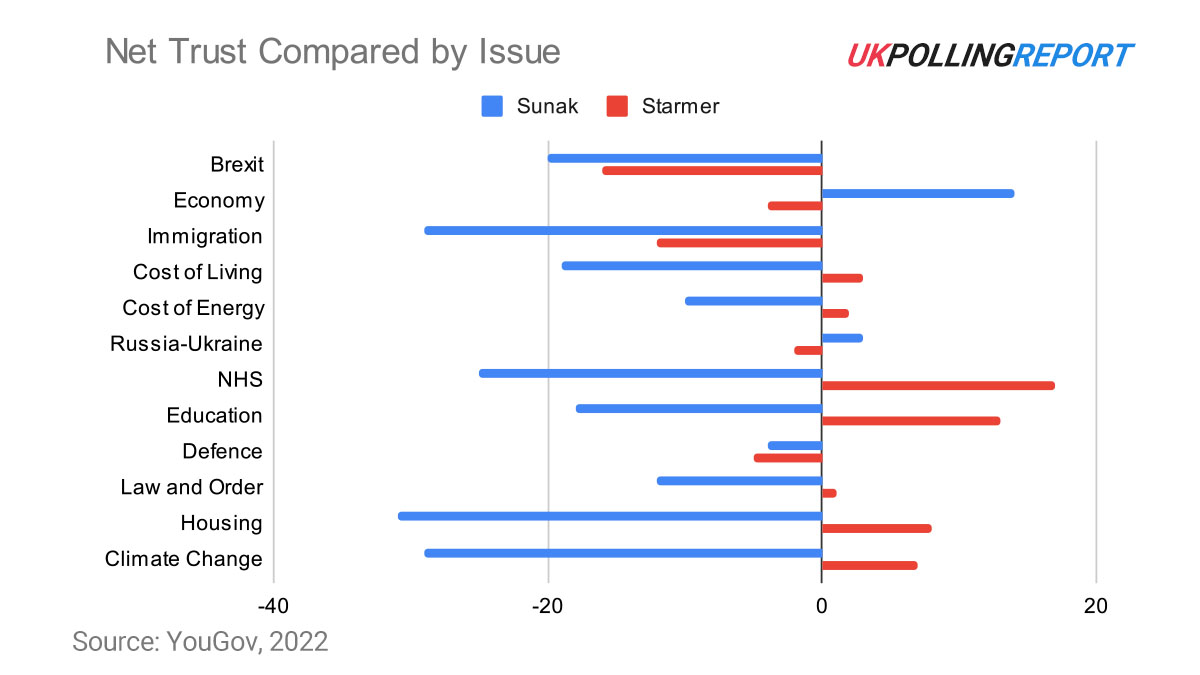
Recent polling from YouGov has taken a look into how much the public trusts the main party leaders on a variety of key issues and it doesn't make pleasant reading for the Prime Minister. Respondents were asked how much they trusted each leader by issue, with the net results, that is the sum of "trust a lot" and "trust a little" less "do not trust very much" and "do not trust at all", shown below.
Far more respondents were skeptical of the Prime Minister across almost every policy area listed. He only saw positive net trust on the economy and the Russia-Ukraine conflict. This is in contrast to Starmer who saw positive ratings across a range of issues, particularly on managing the NHS and Education. These results do echo longstanding trends of Party issue ownership, with Labour more trusted on public service provision and the Conservatives on the economy.
In the same poll, voters ranked the cost of living, cost of energy and economy as the most pressing issues facing the Prime Minister. This may provide some solace to Sunak, who leads considerably on the economy. Though he does still lag behind Starmer on both the cost of living and energy. Sunak would also be concerned with his net -29% on immigration and asylum, trust on this so lacking for the Prime Minister that it's the only issue where he sees negative trust even amongst just 2019 Conservatives. The problem is made worse for the Prime Minister as these voters rank immigration as the next most salient issue facing him (after the three previously mentioned).
Despite these somewhat resounding conclusions on issues, Sunak leads Starmer on a number of personal attributes. This should certainly introduce some caution into any sweeping conclusions.
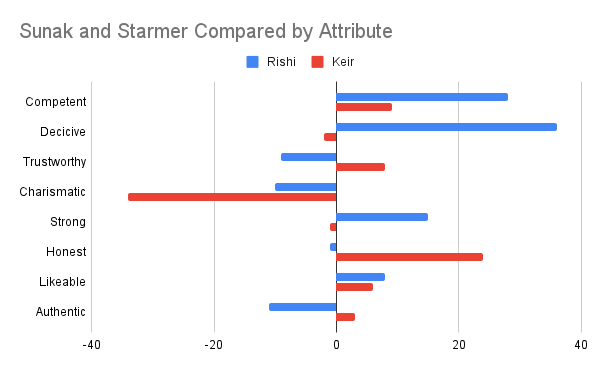
Voters rate Rishi above Starmer on net competence, decisiveness, charisma, strength and likability. Whilst Starmer leads on authenticity, honesty and trustworthiness. This does seem to indicate although Starmer and Labour have the advantage on policy concerns, Rishi has some advantages personally. It points to what other polls are suggesting: That the Conservatives are very unpopular, though Rishi himself is broadly liked.
Rishi's low ratings on authenticity, honesty and trustworthiness may hint at some displeasure arising from his personal wealth, visa status or his wife's non-dom taxes. Whilst Keir's woeful charisma ratings could be exacerbated by Conservative attack lines on the issue. It is worth noting that Rishi received higher proportions of "don't know" responses than Keir, indicating many voters may be yet to decide on him either way.
Another source for these seemingly conflicting results could be the respective roles of Rishi Sunak and Keir Starmer. As Prime Minister, Sunak is accountable for the actions and record of the government. This might induce voters to punish his ratings on policy specifically, especially if there is a perception the government is failing. Meanwhile Starmer can criticise the government without being held responsible for policy failings. In a similar vein, as Prime Minister Rishi has the opportunity to make decisions and govern, allowing him the chance to come across as competent and decisive.
Hence although this polling paints a seemingly contradictory picture, it could be explained by a number of factors. It also does fit into the broader picture that Rishi is somewhat popular whilst the Conservatives are not.