Why Conservatives are Conflicted Over Housing
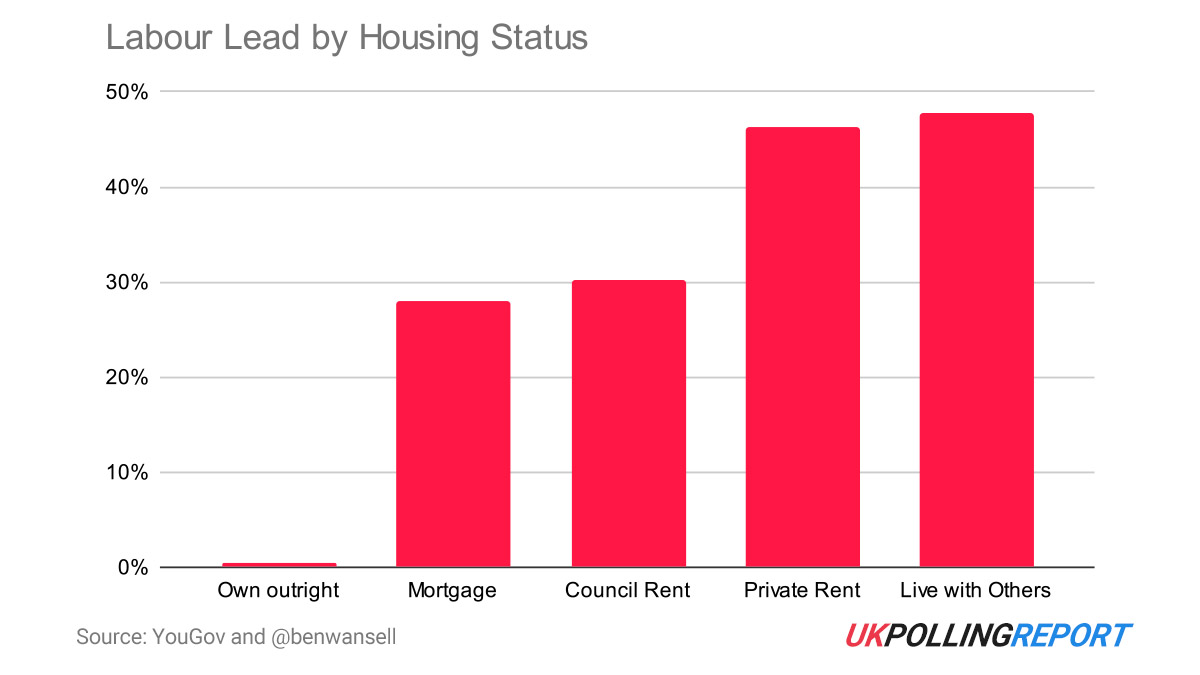
As a backbench rebellion has forced the government to pull a vote on housing targets, the Conservative Party has found itself in a public debate over planning and broader strategy. Paul Goodman at ConservativeHome has written a good article on the party's dilemma. Recent polling from Ben W. Ansell and YouGov has focused on the salience of housing tenure as a political cleavage and can provide useful context to these discussions.
There is a striking relationship between party support and housing status: with the key dividing line being between those who own outright and all others. Far from a Thatcherite ideal, the poll shows that homeowners with mortgages show a preference for Labour, even relative to the national picture.
The relative support of outright owners for the Conservatives perhaps underlines why rebels may have been so happy to take on the government over the issue. In a national context as unfavourable as currently exists, MPs will want to strengthen their own local campaigns to constituents. For many Conservative backbenchers, this means appealing to homeowners.
This argument may help marginal Conservatives hold their seats, but it won't help the party make new in-roads in the electorate. When the Conservatives are supported by under a fifth of 18-24 year-olds, eschewing the interests of this group hardly seems like a viable long-term strategy.
Whilst a link between housing and voting behaviour is not surprising, it has been cited a key determinant of voting behaviour for decades, the scale of the relationship is certainly interesting. It is also notable that those who rent from councils or housing associations exhibit only a modest preference for Labour, considering this groups' affinity for the party has long been a central tenant of conventional wisdom.
The importance of housing tenure to political preferences does raise a question of pollsters, namely should they be weighting for it? Whilst some pollsters, including Ipsos Mori, Deltapoll and Omnisis already do, the short answer is probably not necessarily.
Although housing tenure is clearly of note, it is itself strongly related to age. 61.7% of those aged over 65 own their own home outright, compared to just 0.2% of those aged 16-24. Considering how crucial age continues to be as a determinant of voting behaviour, it seems intuitive that much of the relationship between home ownership and voting behaviour can be captured by age. As pollsters universally weight for age, and often social and economic group as well, it seems likely not only will samples already be broadly representative, but that much of the above patterns could already be accounted for.
That being said, a diverse range of methodology is certainly welcome. Moreover, if public debate continues over the issue, and it gains in salience, it is certainly a variable worth keeping an eye on.