Savanta Shows Close Independence Contest as SNP Lose Ground to Labour
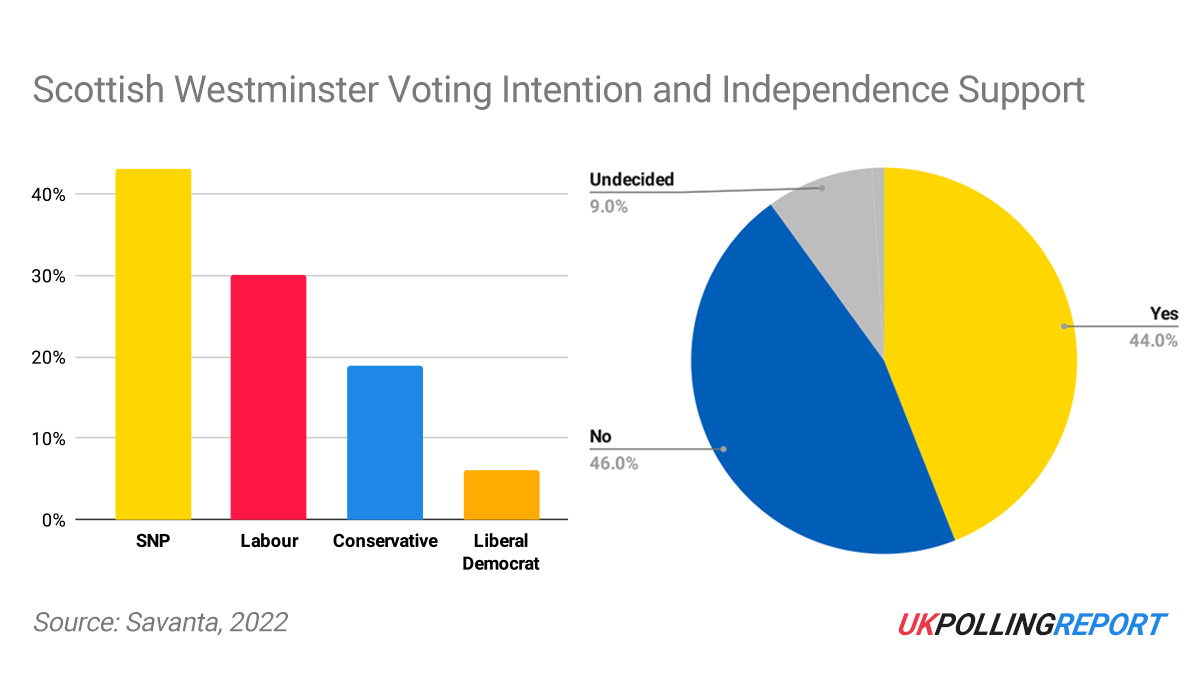
Just as the polls seemed to settle on a solid margin for Independence, Savanta has released research suggesting a far closer state of public opinion. This ended the six-poll streak in favour of independence, giving "No" a margin of 2%. With undecideds excluded, it gave Yes 49% to 51% for No. This marked no change from Savanta's Independence polling conducted at the start of October - before the Supreme Court decision and the resignation of Liz Truss.
Although this seems to complicate the state of polling, in reality it could help clear things up. Whilst it followed successive and somewhat concordant margins for independence, there hadn't been a similarly clear picture of Westminster voting intention. Ipsos put SNP vote share at 51%, YouGov at 43% and Redfield & Wilton at 41%. This new Savanta polling puts the SNP at 43%, Labour at 30% and the Conservatives at 19%. It very much seems as though the 43% figure is most realistic, and the 51% an outlier (as previously covered). This is more in line with national polling which provided little evidence of an SNP surge.
Going by YouGov's last published tables - Savanta are yet to release theirs - Labour is gaining around 11% of 2019 SNP voters and 24% of Conservatives. Whilst the SNP have also gained 12% of 2019 Labour voters, this is a far smaller nominal value as Labour had a significantly lower vote share in 2019.
To an extent, these could be similar patterns to national trends. The Conservatives are losing out to Labour as the main party of opposition. Though there may also be another dynamic. Savanta's poll points to a personal decline in Nicola Sturgeon's favourability. Which could hint at some sense of fatigue with the Scottish leader, perhaps allowing growing independence support to be decoupled from SNP vote share - around 22% of current Labour voters back independence, even with a large number of Conservative switchers.
A number of those swapping from the SNP could also be progressive voters, less intent on independence, leaving the fray as a credible progressive alternative to the SNP arises. This is suggested by the fact current Labour voters are less inclined to support independence than those voting Labour in 2019, at 28%.
Where do these shifts leave independence support? Broadly, the weight of evidence does still suggest a gain for the "Yes" camp. Though Savanta's poll casts doubt on the margin for this. What seems clearer is that this isn't necessarily helping the SNP, at least for the moment. This might change were an election campaign to be built as a "de-facto referendum", though it is by no means a sure thing.