Public Wants More Climate Action, They Just Don't Want to Pay for it

As John Kerry is set to deliver the 2022 Fullbright Lecture, Ipsos MORI has conducted polling to mark the event. Researchers lead with the finding that both the UK and US publics think the costs of climate change will outweigh the costs of dealing with it, however there is a slight sense of apathy towards the issue.
While the British public agrees action is needed on climate change - 62% say the UK needs to do more - voters are less willing to commit to putting their hands in their own pockets. 28% say they would pay more in taxes to deal with climate change, compared to 37% responding that they wouldn't. The two seemingly contradictory statements illustrate the need for caution in interpreting and publicising polls. From this, it would be unfair to claim voters are opposed to climate change action, though it would also be inaccurate to claim they're enthusiastic proponents of radical action.
It does show the British public is keen to tackle climate change, though it's perhaps not at the top of the agenda given current circumstances. It could also lend strength to another finding that the public believes other social actors, beyond the state, need to step up to deal with the problem. The fact the public is more inclined to support policies that don't personally cost them is by no means universal, though is evident in polling elsewhere.
The poll also puts Britain's political polarisation into context. On the issue of the economic costs of climate change, the UK is less divided along party lines than the US. The gap between Democrats and Republicans saying the costs of climate change will be greater than the cost of mitigation is 21%, in the UK it's 8%. This might not come as a shock to those who follow US politics.
Given this, it may be surprising that the gap is greater in the UK on whether developed nations are being asked to sacrifice too much on climate change. In this context, the Conservatives are placed between the US parties, with Labour far more likely to agree that developed nations are not being asked too much. This finding perhaps reflects the fact the issue received partisan attention during COP 27, with Labour coming out firmly in favour of "loss and damage" payments and Conservative figures publicly criticising it.
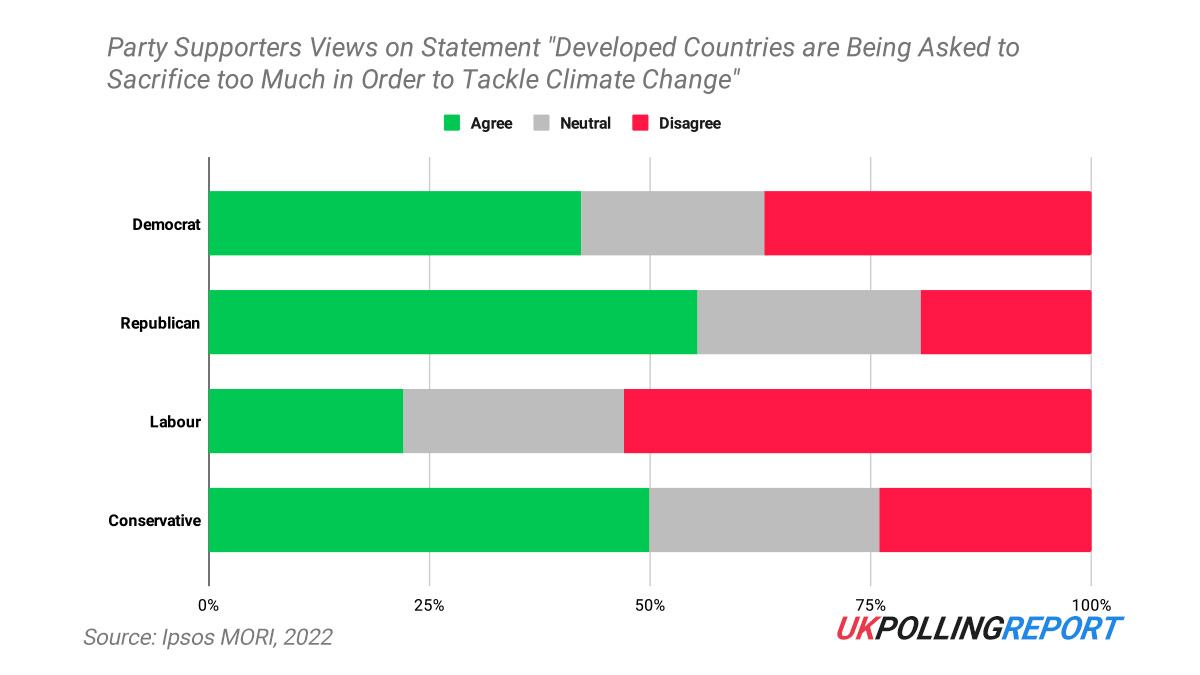
Overall, the polling certainly provides insight into the relative views of British and American voters on the issue of climate change. It points to the complexities of public opinion more generally, and specifically that differences between public opinion in the two nations are not uniform, even on this single issue.