Public Have Low Expectations of Sunak's Pledges, Starmer Doesn't Fare Much Better
Say what you will about Rishi's five pledges, and the level of ambition on display, it's clear they're in touch with the priorities of voters. Three of the pledges are focused on the economy, consistently the top issue for voters, one is on the NHS, a close second, and the final pledge is on immigration – the next biggest concern of Conservative voters. As previously covered, Rishi also carries low expectations (not necessarily a bad thing) and new polling from Ipsos MORI can shed further light on this.
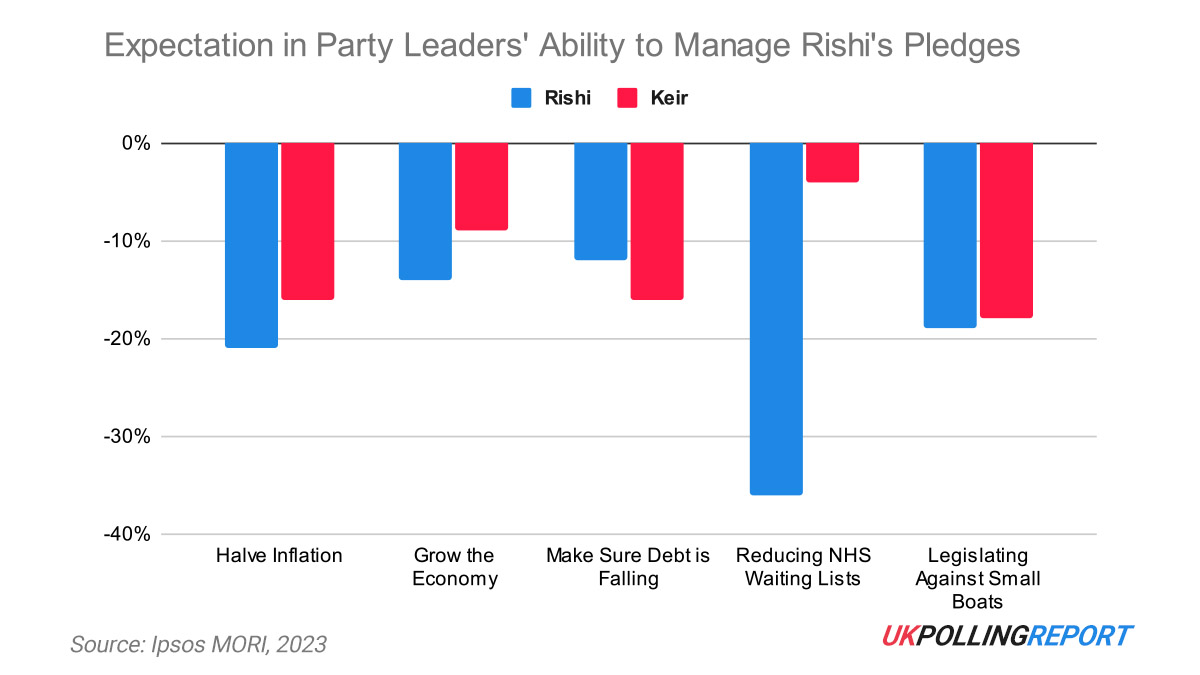
The pollster asked voters whether they thought a Conservative government led by Rishi Sunak, or a Labour one by Keir Starmer, would do well or badly on each pledge, with the net responses graphed below.
On the headline element of every pledge, more voters expected both leaders to do badly than well. Rishi Sunak fares especially poorly as expectations of his abilities are lower than Starmer's on four out of five of the pledges. The public have particularly low confidence on his ability to deal with NHS waiting lists - unsurprising considering the party's standings on the issue.
Sunak takes a rare lead over Starmer on reducing the national debt, even though a lot of polling has the Conservatives behind Labour, and even Rishi behind Keir, on the economy. It could be explained by the fact that national debt has long been a core tenet of Conservative economic arguments. Even though their economic credibility is tarnished, they may retain some residual credibility on debt. This may also be helped by the fact Rishi himself emphasised the issue during summer's leadership contest against Liz Truss, whilst, according to the OBR, his recent fiscal statement is also set to see debt fall as a proportion of GDP.
Although these findings - of only a slim Starmer lead - might worry Labour, they can be made in the context of Sunak's strong personal ratings. In addition, the pollster also asks the same question of the sub-heading of each pledge and Starmer does fare somewhat there. His ratings even go positive on "securing the future of Britain's public services" and "ensuring people can get the NHS care they need quickly".
Perhaps the most insightful element of the survey comes as voters are asked to prioritise each of the pledges (separated into the headline and further detail). In line with national polling, "Easing the cost of living and giving people financial security" comes out top, with the two elements of Rishi's NHS pledge second and third. This diverges from prior polling, where the NHS had been by far the top pledge, and points at the significance of framing.
Where "halving inflation" and "growing the economy" come fourth and fifth, on 36% and 34% respectively; framing economic issues in the context of providing financial security and the cost of living puts it much higher, at 61%. This suggests that if Rishi wants his pledges to cut through, he should emphasise tangible consequences, rather than abstract economic concepts. Where this leaves Jeremy Hunt's inflation explainer is anyone's guess.