Pollsters Converge on a Mid-Teen Labour Lead as Conservatives Win Back Switchers
According to our polling average, Labour's lead is now sat at 15.7% - that's a decline of just over 1% since mid-April, when I last covered the party's diminishing advantage. One positive development for Keir Starmer is that this decline does seem to have slowed more recently - it's down just 0.2% on this time last week. So, have Labour stemmed the bleeding?
Right now, it's difficult to say. Although movement in the polling average seems to have slowed, most polls over the past week, with the exception of Redfield & Wilton (which was the most recent), have had the Conservatives making gains. Based on this, and unless the Redfield result is the start of a reversal, it is likely our average will narrow further.
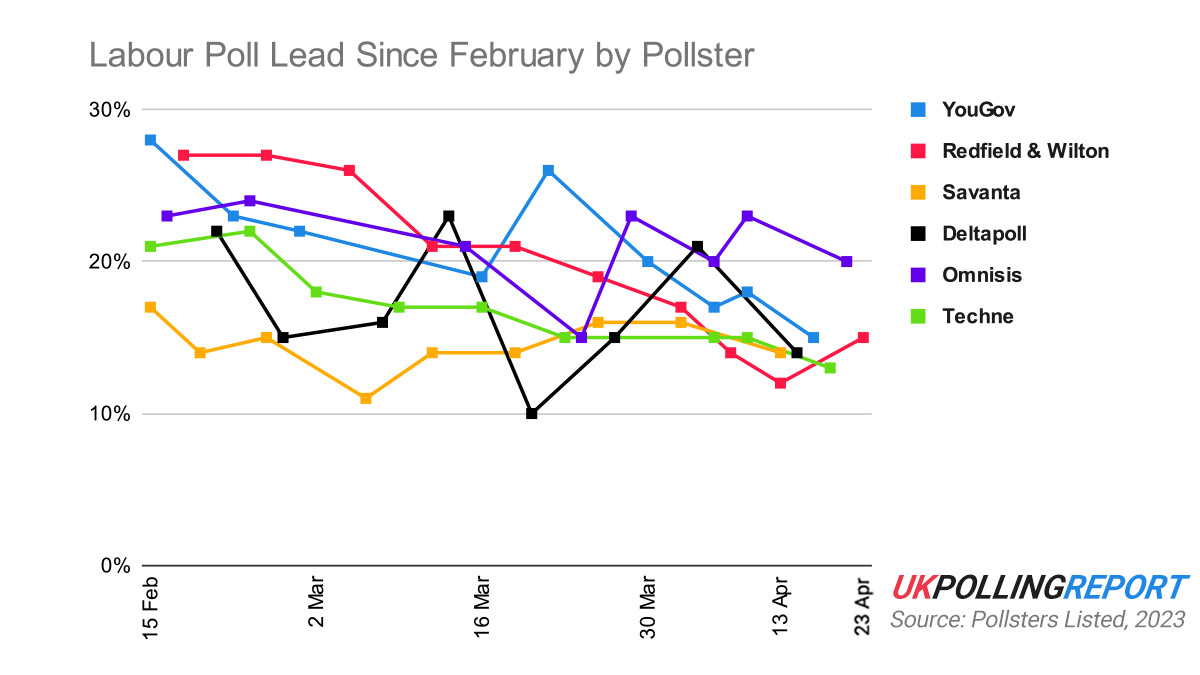
We can look more closely at movements in the polls by separating results according to pollster - with the top six most productive listed below. Since signs of closing began, in mid-February, YouGov and Redfield & Wilton have shown by far the largest narrowing. YouGov's Labour lead has shrunk by 13% - from 28% to 15% whilst Redfield has this at 12%. Techne also has a consistent pattern of decline, though of a smaller magnitude - from 21% to 13%.
When compared to the rest of the field, there is a fairly significant divergence. Omnisis, Savanta and Opinium have shown the polls closing by just 3%, 3% and 2% respectively. Deltapoll is an interesting case, although their Labour lead has decreased by a middling 8%, it's clear from the chart that their numbers are subject to significant bounce week on week.
Taking a closer look into the more extreme cases, the large shift from YouGov and Redfield & Wilton seems driven by a decline in the number of Con-Lab switchers. These voters are of particular value to Labour's lead, as if they can be won back it simultaneously boosts the Conservatives' vote share whilst diminishing Labour's. Taking the two YouGov polls from across this period the number of Con-Lab switchers decreased by 6%, whilst the number of Con-Don't Know's only decreased by 2%. Taking comparable polls from Redfield & Wilton, the figures are very similar, with a 7% decrease in 2019 Conservatives now voting Labour and a 1% decrease in "Don't Know" responses. Unsurprisingly, pollsters reflecting a smaller shift don't find comparable figures.
Despite this seemingly conflicted process, the aggregate result is that - with the exception of Omnisis - pollsters do seem to have converged on a Labour lead in the mid-to-low double digits. Labour will be hoping it doesn't continue to drop below this mark.