New Year round up: The Conservatives
Looking at the Conservatives in 2007 I think there are two interesting questions, and one observation. To take the questions first, how much of the Tory progress is down to them, and how much have they just benefited from Labour's misfortune? Secondly, are they doing well enough to be on the road to power next time round?
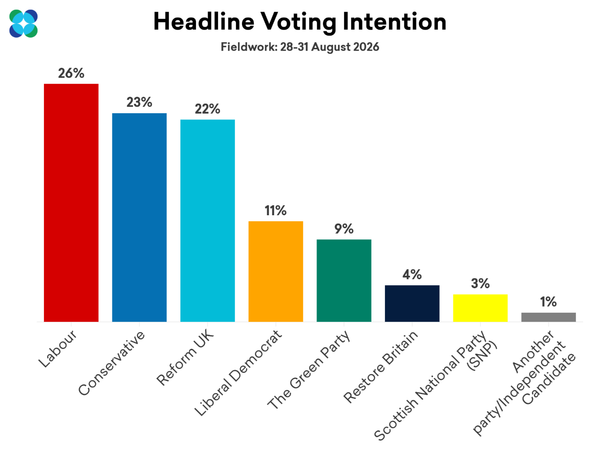
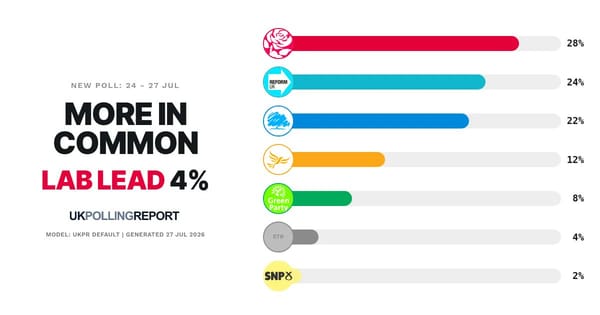
While most Conservatives are probably pretty happy with the headline figures in the polls at the moment, I think it's hard to argue they've made particular progress in themselves. Headline voting intention figures are a zero sum game, the don't knows and won't votes are taken out, and those people who do vote have to vote for somebody, even if it is only the least worst option. Looking at other questions like economic competence, or best Prime Minister, or best party on issues we see the Conservatives pulling level or overtaking Labour, but only by small amounts. In most questions there are huge swathes of respondents who say don't know. This isn't necessary a problem for the Conservatives, a vote for them as the least worst option counts just the same as a vote from a committed Conservative come election day, but it does suggest we are seeing them progress because Labour are faltering, rather than because of a great swell of support for the Tories.
The one instance where the Conservatives really did seem to push forward themselves was when they were up against the wall at conference season, then, and for the month that followed, they seemed to control the political agenda and did briefly seem to address what polls asking about perceptions of the Tories and reasons why people are still uncertain about them suggest is their problem: people don't know what they stand for, people don't know what they would actually do, and people don't know who the hell most of them are.
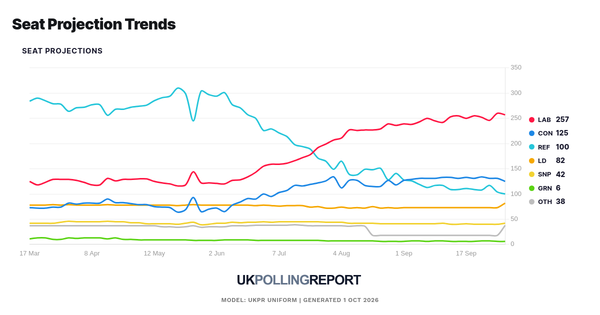
The Tory revival in early October was dramatic - if you look at the graph of voting intention polls on this site you can see the blue line shoot straight up in early October as the party leapt from the low thirties to around 40% and did so almost overnight. Exactly what caused the revival is more interesting, because there are a couple of possibilities. The straightforward one, and one that lots of Conservative commentators immediately jumped upon because they wanted it to be true, is that it was the offer of tax cuts that made people support the Tories. For right-wing Conservatives this explanation was manna from heaven, all that nasty touchy-feely, tie-discarding, windmill-installing wooliness wasn't necessary after all, all it needed was good old tax cuts. Unfortunately for them this probably didn't explain the recovery (as has since probably become clear to all), since despite the offer fading from memory and Labour shooting the Tory fox in their budget, the Tory 40% persisted.
A second explanation was that the Tory recovery was due to them correctly addressing what actually was the factor that was holding them back. They gave a consistent message at the party conference, Cameron put across a vision that people understood, the party offered concrete policies like cuts in inheritance tax funded by charges on non-domiciles and George Osborne at least performed capably enough to give the impression that there was a team beyond Cameron himself. They stood for something. That was my own explanation, but unfortunately it too can't really explain the position fully, since the message had faded, the policies have been superseded, and yet the Tories are still at around 40%.
A third explanation is that the Conservatives did nothing at all, it was all down to Labour's own mistakes and the Conservatives are the undeserving recipients of Labour's lost support. This doesn't really work either, the press did seem to turn against Labour half way through the Tory conference after Brown's announcement of troop withdrawal on his surprise visit to Basra, but that wasn't enough to explain the turnaround in the polls. The real Labour disasters: "chicken Saturday", the funding scandal and the data loss all happened after the reverse in the polls.
What I think actually happened was a mixture. The initial recovery was from the Conservative conference, the offer of clear policies, a good speech by Cameron and some positive coverage, it was a conference bounce that would have subsided. However, it was enough to panic Gordon Brown into not calling an election, a calamity to his public image that gave the Conservatives a real 40% in the polls. In the same way the Conservatives underestimated the boost Labour would get from Brown becoming PM, Labour apparently underestimated the boost Cameron would have got from the Tory conference and it panicked them into not having an election - in my view, if they had gone for it they would have won it.
Still, they didn't, so are the Conservatives on the road to winning the next one? I am not a fan at all of deterministic sort of views of politics. There is no lead beyond that necessary on polling day that a party in opposition must achieve in order to survive an inevitable drift in support back to an incumbent party. It is not written in stone that governments recover as they head towards the end of a Parliament (if there is, the causality probably works in the other direction...governments call an election because the figures look good, the figures don't look good because an election is due). In the last two Parliaments Labour did not recover from their poll ratings mid term, rather the trend for Labour since 1997 has been gradually downwards, rather than mid term falls and election time peaks.
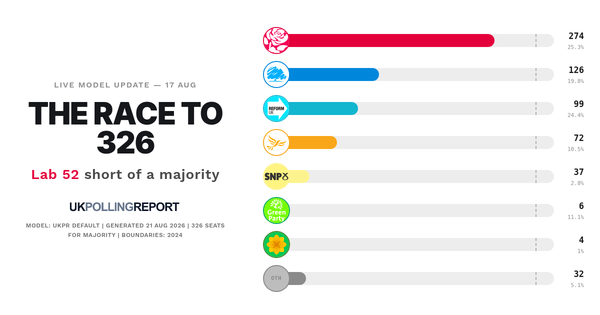
Labour may recover before the next election (though as I wrote in the previous post, my personal view is that they will not recover significantly while Brown is Prime Minister), the Conservatives may extend the gap, it may stay much the same. Polls cannot predict the future. All we can look at is whether the sort of lead the Tories have at the moment would be enough. On a perfectly uniform swing, the Conservatives need to be somewhere around 11 points ahead to get an overall majority. In practice many of the polls we saw late last year would also have given the Tories an overall majority, because they also imply lots of seats gained from the Liberal Democrats. In actual fact, I suspect the Tories would get an overall majority on a lower lead than that anyway.
The so-called bias in the electoral system is partly to do with structural things like the time-lag in boundary changes and over-representation in Wales and declining inner-city areas, but it is also largely to do with more variable things like tactical voting. It is hard to imagine that, were support for Labour really to drop to 30% and the Conservatives rise to around 40%, that tactical voting would continue to be largely against the Tories rather than Labour. Equally while uniform swing is a very good predictor of relatively small swings in the marginal seats, it breaks down towards the edges - there is not going to be a swing of 7% to the Tories in Liverpool and Glasgow however well they are doing. There probably isn't in deepest darkest Surrey where everyone votes Tory anyway either.
The swing Labour achieved in 1997 was by far the largest since 1945, almost twice as large as the second biggest in 1979. Labour's tally of seats in that election was significantly above that predicted by a uniform swing projection, under extreme circumstances the formula broke down. If the Conservative are to win the next election they too would need a very large swing by historical standards, and I would expect such a dramatic shift in opinion would hide within it shifts in the distribution of votes, of the direction of tactical voting and so on.
Are they on the road to a victory? Well, I already said that I don't think Brown can recover, so by default - as ever, barring events - the Tories probably are. But it might be as a minority government in a hung Parliament or with a tiny shoestring majority. From there you can imagine all sorts of long term results, it could be a pyrrhic victory with a fractious Tory government collapsing under the pressure of a tiny majority... or it could be a brisk canter towards a second election consolidating a decent majority against a demoralised and disorganised Labour opposition. To get a workable majority there probably needs to be more of a positive appetite for a Conservative government.
The question that I ponder with regard to the Tory party today is whether John Smith would have won in 1997 had he lived, in other words, if Labour hadn't completed the change of image that took place under Blair in opposition could they still have won? While Cameron has made progress in changing perceptions of the Conservative party, he hasn't really overhauled it like Blair did. He is probably where John Smith had got to before his death.
I think Labour would have won in 1997 with Smith. They'd probably have won with a baboon wearing a red rosette, given the huge public desire for a change in 1997. Labour's position now isn't that bad - we aren't a level where the Conservatives will win regardless of how awful they are - but do I think it has reached the point where the Conservatives will record some sort of victory by default as long as they don't blow their chance through infighting, scandal or manifest incompetence. At the last three election they were, to varying degrees, so manifestly toxic that many people simply couldn't bring themselves to vote Tory however bad Labour were. I think Cameron probably has sufficiently cleansed them to allow them to ride in on the mood for change, even if they haven't done much to deserve it.
In short, my prediction is that Labour have done enough to lose the election and for the Conservatives to be the largest party. The Conservatives still have a way to go to be confident of a workable majority though, and they still have time to fluff things up if they aren't careful.
I said at the start there were two questions and an observation. How much of the Tory progress is down to Labour's misfortune? Most of it. Are they on the road to victory? Of some sort, yes. The observation? We should remember quite how close to disaster they came at the end of September. Prior to the Tory conference people I know within the party expected an election, and expected to lose badly. David Cameron would have been finished, the renewal agenda with him and the Conservative party would have been staring into a very deep, dark abyss indeed. The Conservatives may be in a nice position now, but they came perilously close to destruction. Memento mori.