More from today's Sunday Times poll
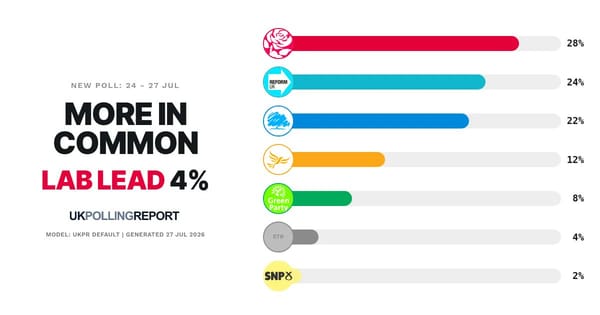
The tabs for the weekly YouGov poll for the Sunday Times are now up here. Topline figures are CON 32%, LAB 36%, LDEM 8%, UKIP 13%, GRN 6%. The poll was conducted on Friday and Saturday, and the four point Labour lead equals the highest this year, so it looks like it could be an impact from the Paxman interviews. Then again, YouGov spat out a single four point Labour lead in one of their daily polls earlier this month that turned out to be just random noise, so this is nothing that couldn't just be random error. To have any confidence about whether anything actually has changed in terms of voting intention, we need more polling.
In the meantime, what does the rest of the poll show? Well, leadership ratings do also suggest an improvement for Miliband. Asked if they are doing well or badly David Cameron's net rating is up from minus 5 last week to minus 2 this week. Ed Miliband though is up from minus 39 to minus 29, so a solid jump (that said, Nick Clegg is up from minus 47 to minus 40 without being in the interviews at all...). Miliband also rose in the Best PM question - up four points since YouGov last asked this version of the question in November last year, but still 12 points behind Cameron (when YouGov ask the question for the Sun it's Cameron v Miliband v Clegg, for the Sunday Times Farage is also an option - don't compare the two, they give different results).
On the debate question itself, amongst people who watched the debates 49% of people thought Miliband came across better, 34% thought David Cameron did. This is of course very much in line with a movement to Labour in the headline voting intention figures... but why so different from the ICM poll after the debate? Part of the answer may well be that people have had longer to digest it, think about it and be influenced by discussing it with other people. First reactions are extremely important, but they aren't everything.
Another factor though is who watched the debate - the ICM poll was weighted to be politically representative (though even weighted, the poll still ended with a sample showing an 11 point Labour lead rather than Con and Lab neck and neck), but a debate doesn't necessarily get watched by a representative sample of the public. People from one party maybe more likely than another to watch it. Looking at the YouGov data, 31% of people who voted Labour in 2010 watched the debate, only 15% of people who voted Tory...so the sub-sample of people who watched the debate was actually a very Laboury group of people to begin with. This highlights a methodological challenge for pollsters in doing things like debate polls, how do you weight the sample? Do you try to make it politically and/or demographically representative of the country as a whole, regardless of who is actually watching? Or do you try to make it representative of the people who are actually watching, regardless of the political skews that brings? The second is probably more methodologically purer - all you can *really* measure is what people who watch think, but given what the media want is just a crude "who won" verdict, would it be fair to start out with a sample that was stronger biased one way or another?
Anyway, time will tell if the Paxman interviews actually did or did not make any difference. On other matters, YouGov found 11% of people said they were voting tactically at the election. Amongst that (obviously very small) sample people were pretty evenly split between voting tactically against the Tories (40%) and voting tactically against Labour (37%).
In my weekly round up I mentioned some YouGov polling about which taxes would rise under a Labour or Conservative government, conducted before Prime Minister's Question time, Cameron ruling out a VAT rise and Ed Balls ruling out an NI rise. YouGov repeated those questions in this poll to see if they had changed. At the start of the week, 31% of people thought VAT would rise if the Conservatives won. Following David Cameron ruling out a rise in VAT, this is now...32%. At the start of the week 39% of people expected national insurance to rise if Labour won, but since Ed Balls ruled it out, that has changed to... 40%. A lovely illustration of how much of the politicians' arguments, exchanges and pledges make not the slightest difference to public opinion.