Lee Anderson Should Think Twice Before Waging a Culture War
Prior to Lee Anderson's promotion to Party Deputy Chair, he argued at the New Culture Forum that the Tories' 2019 victory was down to Corbyn and Brexit. He continued that in the next election "we’ll have to think of something else. It’ll probably be a mix of culture wars and trans debate.” Well, Anderson is now in a role with responsibility over party organisation, and a tweet directed at Nicola Sturgeon has suggested he's doubling down on this strategy. Before Lee gets too carried away, it may be worth taking a look at what polling has to say about such an approach.
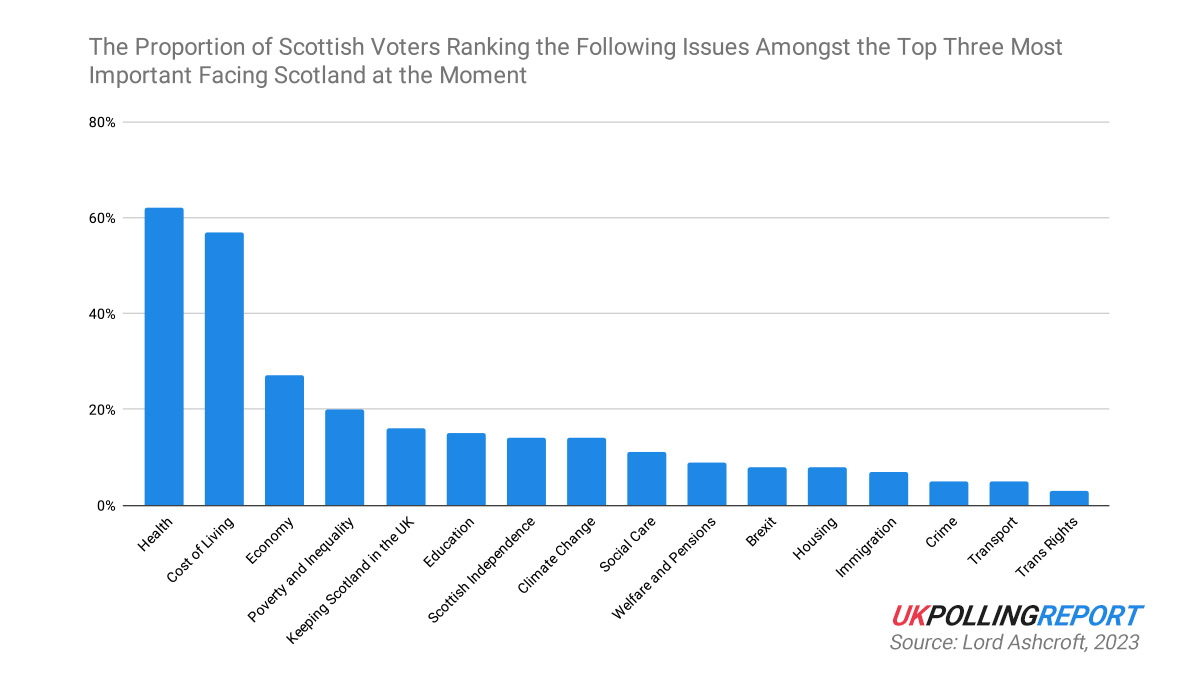
Firstly, and most importantly, whilst 'culture wars' issues may be high on the agenda of some sections of the media, they're not listed amongst the top priorities of voters. Far and away the main concerns related to the economy and healthcare. When voters are prompted for views on trans issues, the topic scarcely registers as a top concern for even 3% of voters. This was shown in Lord Ashcroft's recent Scotland poll, where even after protracted public debate over the issue, just 3% of Scots put it as a priority.
Further to this, whilst some punditry from the right has hailed Sturgeon's resignation - and apparent plummeting polls - as a vindication of a culture wars strategy, the reality is less clear-cut. It's worth saying Scotland's gender reform bill was certainly unpopular - and has correlated with a slight decline in Sturgeon's personal support - though to establish a direct relationship is difficult. There are plenty of reasons why, after 9 years in power, opinion on Sturgeon may be fluctuating.
One explanation, also posited by Lord Ashcroft, is that this comes from what the trans debate signals about Sturgeon's priorities, rather than the unpopular policy in itself. Independence and gender reform are ranked by Scottish voters as the SNP's two top concerns. These are completely out of kilter with national priorities. It is plausible that this disjunct, rather than Sturgeon's policy itself, is accountable for recent polls.
This is not to say that a culture war strategy can't bear fruit; it seems as though the Scottish Conservatives have made some progress. Though it should introduce some important warnings to prospective culture warriors. Political actors could be better placed to make headway on popular, less salient, issues if they're not perceived to be instigating them at the expense of more important concerns. This may be especially pertinent for parties in government.
To be fair to Lee Anderson, there are salient 'culture wars' issues. It's easy to imagine some socially conservative policies on immigration and crime could be both popular and address voters' concerns. Though even with this, there is no getting away from the fact that the economy and NHS matter more to voters than anything else. It's difficult to see how a party in government could recover from a 20% polling deficit without some meaningful action or focus on them.