Labour's MRP Landslide Shouldn't Breed Complacency

Savanta have recently published the results of an MRP poll conducted alongside Electoral Calculus and it makes gripping reading. The poll gives Labour 482 seats to the Conservatives' 69. That's a majority of 314. Amongst the headline findings are a Conservative wipe-out North of Lincolnshire. Naturally the poll includes a number of prominent Tory losses – including none other than Rishi Sunak. When mapped, it certainly looks stark...
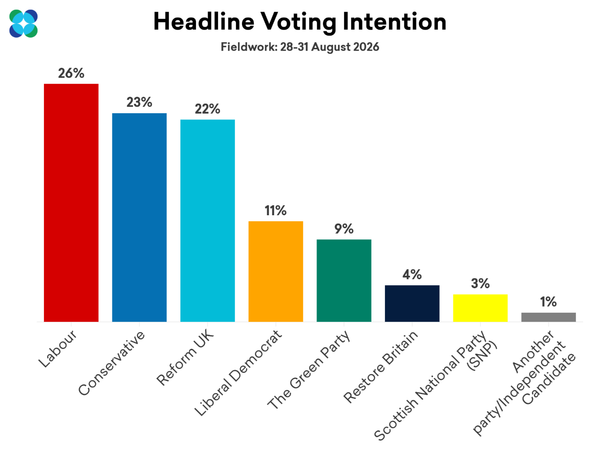
Although it bodes well for Labour, it's worth examining from a deeper perspective. The above forecast would relate to a 20-point Labour lead. To contextualise it, that's considerably larger than Blair's 12.5% in 1997. The vote share from Savanta's poll is broken down as follows:
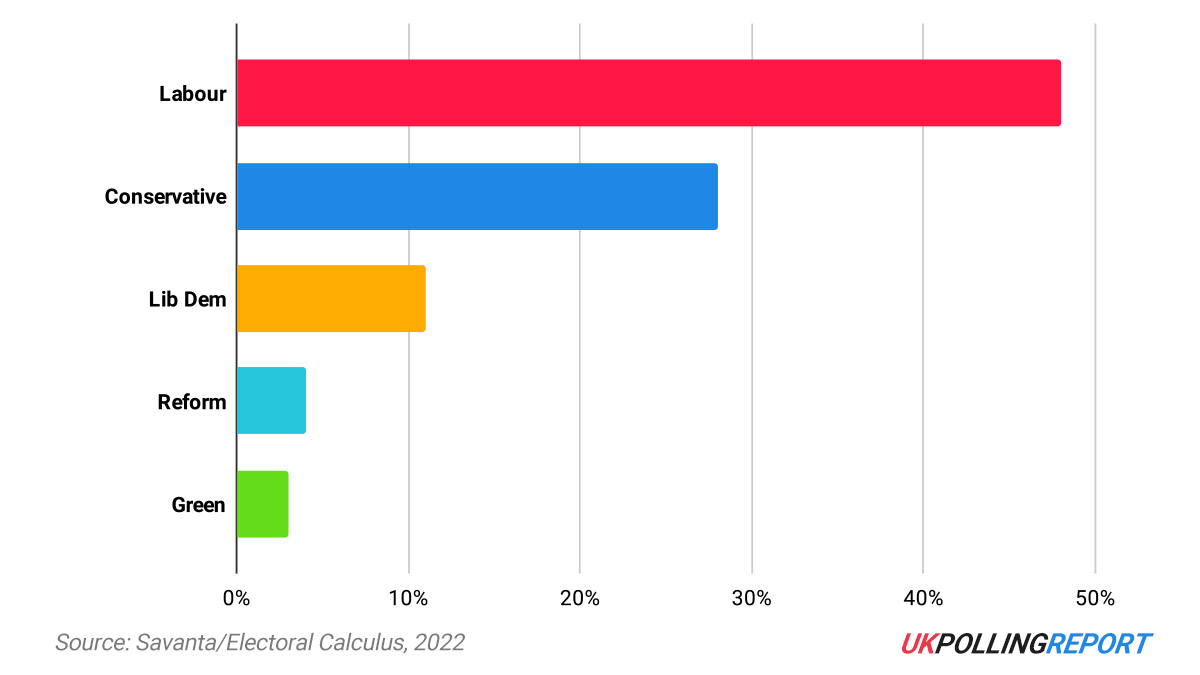
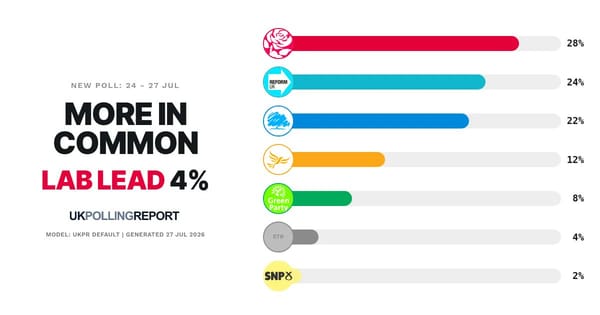
There is divergence from Savanta's Westminster voter intention poll, conducted over the same period. The MRP model gives the Conservatives a vote share 3% lower, Labour 6% higher, the Liberal Democrats 2% higher and Reform 1% lower. This is more in line with other polls of the time. Though the higher Lib Dem and lower Reform vote is certainly intriguing, especially as it seems to resemble the outcome of the City of Chester by-election over recent national polling.
For readers uninitiated in the shiny and ever-growing world of MRP polling (short for multi-level regression and post-stratification), essentially pollsters will ask a larger sample of voters for information about themselves as well as target questions. This then provides a quantitative link between said variables and voter behaviour, which can be applied to a wider data set on an aggregate level; in the case of political polling, across constituencies. It's developed a reputation in UK polling for its success in predicting recent election results, particularly after 2017 where YouGov's MRP model forecast a hung Parliament.
Now it goes without saying, despite its high-profile successes, MRP polling is by no means perfect. In the 2019 election traditional polls came closer to the eventual result, with final MRP predictions tending to undersell the Conservative vote share. Moreover, this specific poll from Savanta uses a smaller sample size, of 6,237, than other MRP polls. YouGov's poll prior to the 2019 election surveyed over 100,000, whilst Opinium's more recent poll with the TUC had over 10,000. It is also, of course, just as fallible to changing public opinion as traditional polling. So as far out from an election as we are now, it shouldn't carry too much weight.
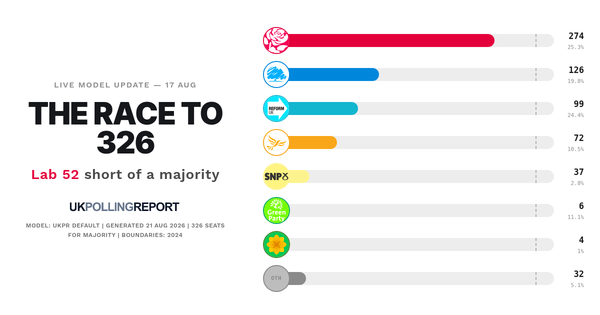
Where the Labour party may gain some confidence is in the translation of vote share to seats. Savanta's MRP model sees Labour over-represented, certainly relative to Uniform National Swing. You only need to look at our model to see the difference. This is notable considering recent discussions of the vote share margin Labour would need to secure an outright majority, rather than a plurality in a hung parliament. It's possible they might not need the double-digit margin some have theorised.
The model also shows the material significance of shifts in the national vote share. Labour's 8% gain on Savanta's last MRP poll translated to a 258 seat larger majority. Even if the Conservatives can't secure an outright victory, small aggregate gains could save a lot of threatened seats. Coupled with some evidence of Conservative gains amongst the most recent national polls, this might provide some solace to accompany the prophecy of a complete collapse.