Labour Voters More Likely to Think the Government Can Afford to Cut Taxes

With Jeremy Hunt's budget fast approaching, pollsters have been looking into British attitudes towards the prospect of tax cuts and deficit reduction. Redfield & Wilton asked voters at large and found some appetite for tax cuts, albeit limited by voters' perceptions of economic conditions.
When voters were prompted for how the government should act were there to be a surplus, more said cut taxes (35%) than reduce debt (29%), increase spend (18%) and save the money (7%). The preference for tax cuts held for all parties' voters, except Conservative supporters, who opted for reduce debt by a margin of 1%.
Unfortunately for those charging for tax reductions, at the same time voters don't think government finances are in a position where tax cuts are feasible. Four in ten think the government isn't in a position to cut taxes, with 32% in disagreement.
Perhaps surprisingly when considering the conventional wisdom on support for tax versus spend, Conservative voters are more inclined to say that the government isn't able to cut taxes than Labour voters. This points to the hawkishness of Conservative voters - perhaps a lasting legacy of the rhetoric of austerity, or a residual Liz Truss effect.
Conversely, a poll of Conservative members for Conservative Home found seemingly contradictory conclusions. It found that two thirds of Tory members wanted to see tax cuts prioritised over deficit reduction.
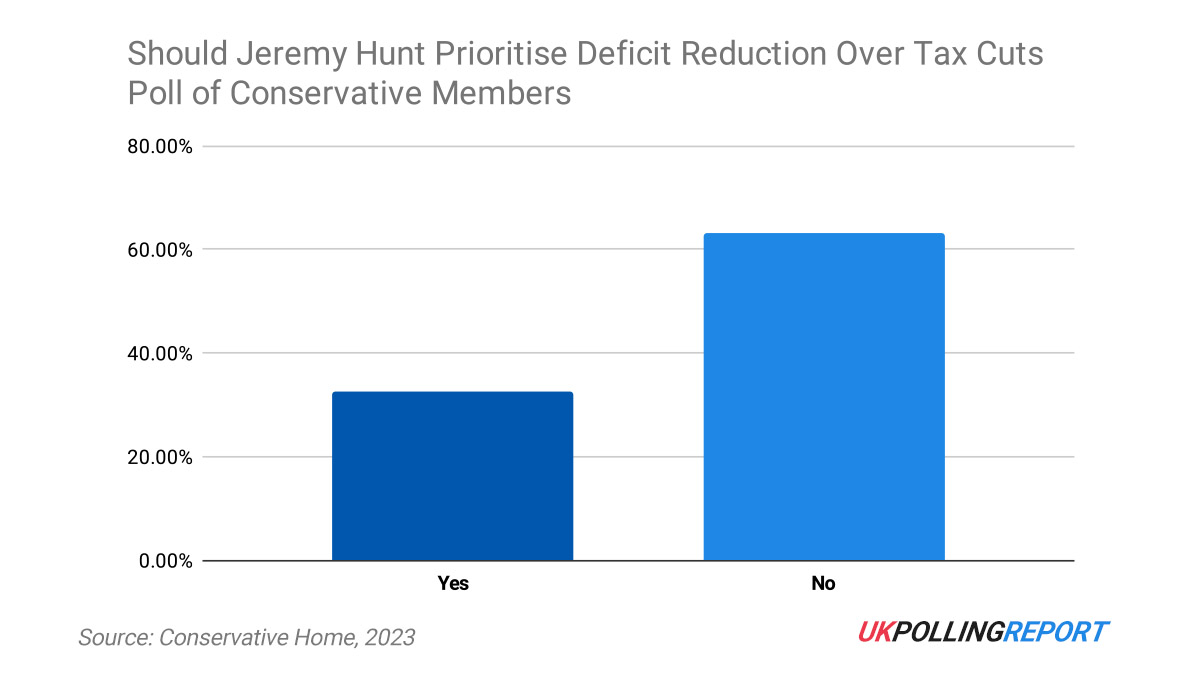
As a poll not from an official pollster with published tables, this could be treated with caution. Though, the fact it is ostensibly intended as a poll of Conservative members - rather than a national sample - does minimise such criticisms. Taking the two polls together, it seems to hint at a divergence in the preferences of Conservative members and voters. Whilst voters want to see deficit reduction, Conservative members are far more open to tax cuts. This may not be as surprising as it first seems, especially considering how crucial this debate was to the 2022 Leadership contest...