Wildly Bad on Wildcards
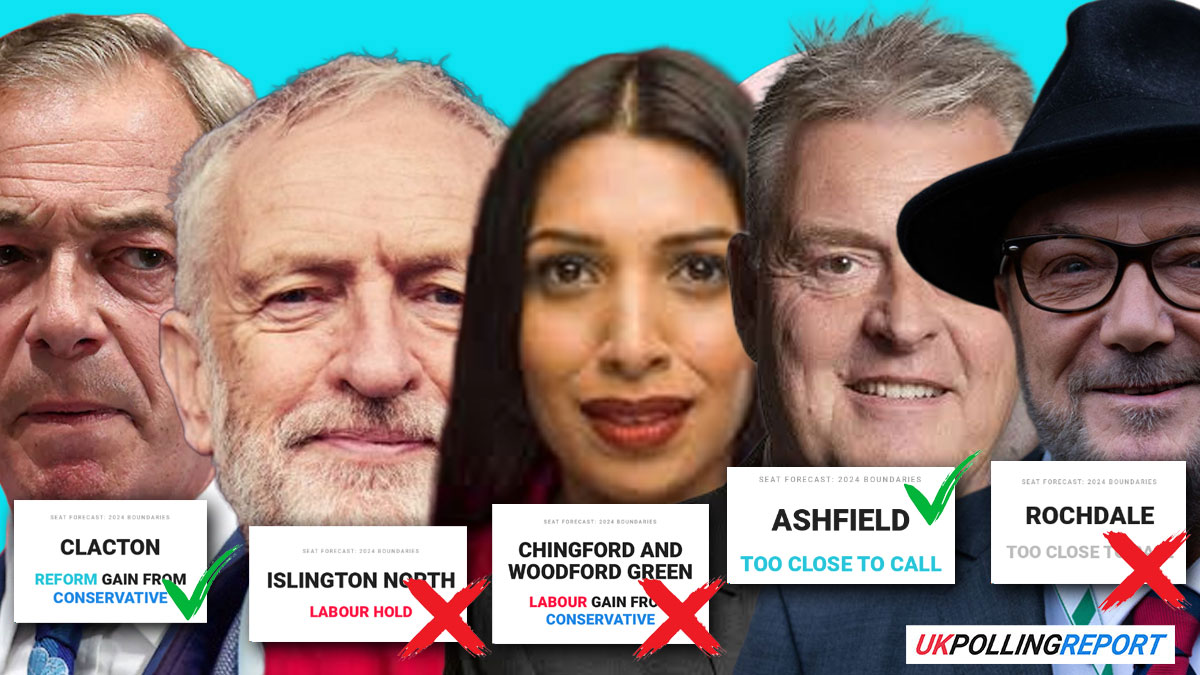
It is now a month after the election and after a break from the frenzy that was, it seems like a good time to reflect on how we did and what we learnt. This is the first of two posts and we are going to get the bad news out of the way first. When it comes to the "wildcard" seats our record is abysmal.
Clacton we got right and did well on the percentages based on our tweak of Survation's single seat poll as well as national trends. Getting the order of the first three parties correct too. Islington North we called wrong, badly wrong - Jeremy Corbyn romped home with a double digit margin over the Labour candidate that we had projected to win. This too like Clacton was based on Survation's single seat pollling. Chingford we got wrong as well, Iain Duncan Smith held the seat with the former Labour candidate Faiza Shaheen splitting the Labour vote after she was deselected as the official candidate.
We had Ashfield and Rochdale as "too close too call" leaning into Lee Anderson and George Galloway winning. So we can claim some mitigation in the sense that we didn't think it was reliable. Lee Anderson did win for Reform, however Labour's Paul Waugh ousted George Galloway in Rochdale. So on the "too close to call" projections we were no no better than a coin toss.
On the wildcard seats our algorithm clearly failed and so too did the pollsters who attempted the notoriously difficult to do single seat polling we used as the basis for modifying some projections. The lesson to draw from this is that national macro-trends really do not apply to special local situations.
Nationally our general election record was much better. Out of 632 projections, we had an accuracy of 87%. Which was better than many of the expensive MRP projections from a fair number of big pollsters. We will get into more detail on that in another article shortly.