Are Reform Really on 9% When Voters Don't Know What They Stand For?

Close followers of polling, or readers of this site, may well have spotted that Reform UK seem to be in something of a renaissance. The party has maintained a strong performance, reaching near double digits, all without the much-prophesied return of their totemic leader. And yet there are reasons to doubt the strength of their support. In recent days alone, their figure has ranged from 2%, according to today's Ipsos poll (which does also give UKIP 2%), to 9% from YouGov. Meanwhile, by-election results have showed little evidence to support the party's re-found popularity.
Polling from Opinium might give some further insight into this. The pollster prompted respondents with competing statements and asked to say which they thought Reform UK agreed with. The findings suggest the vast majority of voters don't have a fully formed picture of the party's platform.
The main takeaway is that a majority, if not a large plurality, of voters are unsure about Reform's policy positions. A large number of voters seem to also have an incorrect view. More voters think Reform UK would support a closer relationship with the EU than not, as they are also split over whether the party supports or opposes more migration. The only issue that a plurality of voters attributes to the party is dissatisfaction with the political system, which is possibly inferred from the party's name.
Even amongst the 18% of respondents who say they would be willing to vote for Reform, 29% say they think the party backs closer relations with the EU, whilst 37% are unsure of the party's position on the issue. Barely a third of Reform-inclined voters think the party stands for lower levels of immigration. Whilst it may be difficult to draw any drastic conclusions without having the same questions asked of other parties, the low level of accurate responses do cast doubt on polls showing Reform on near parity with the Liberal Democrats.
Although voters as a whole may not have a clear picture of Reform's positions, this isn't sufficient to dismiss their levels of support. In this very same Opinium poll, on which the party registered 8%, 79% of Reform voters backed Brexit and half backed the Conservatives in 2019. This is far more in line with expectations, so doesn't support a claim that their support is attributable to low-information voters.
There is still a great deal of uncertainty around Reform UK's figures, as can be shown by plotting their vote share by pollster.
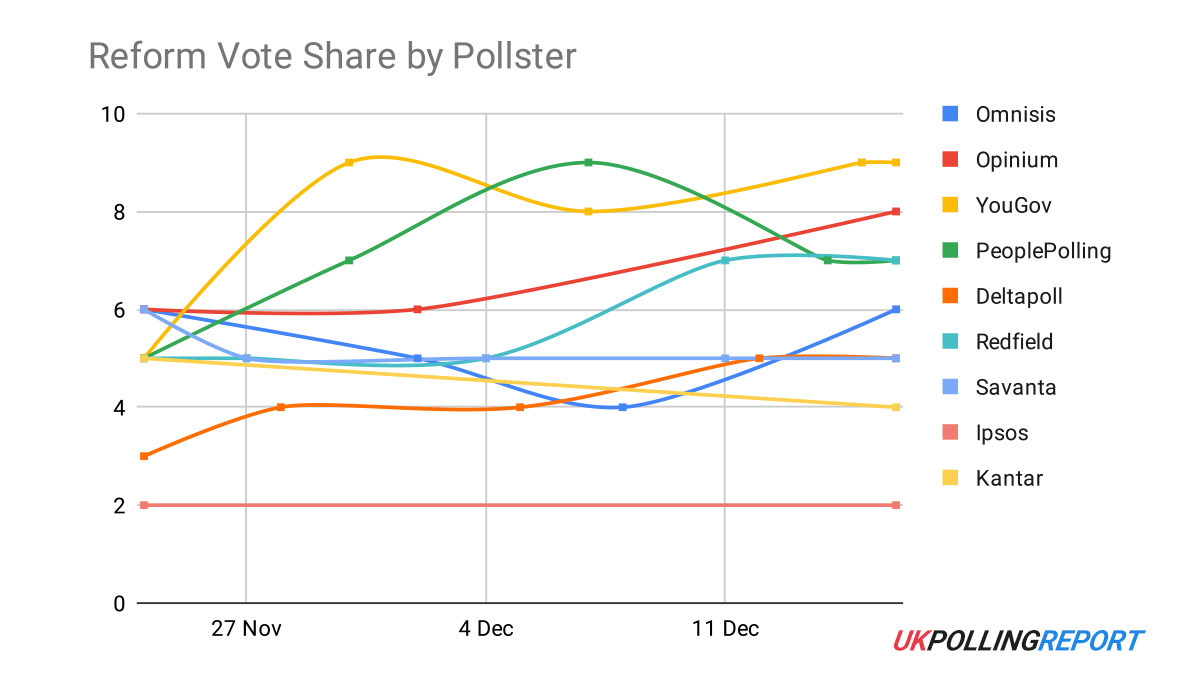
Whilst there has been a clear upward trend in polls since October, this effect has diminished somewhat since. Moreover, it is still not universal, with Ipsos still registering a low vote share, nor has there been much evidence of it in by-elections. All eyes may now be on the West Lancashire by-election in the New Year, which voted to Leave by a margin of 55%, to see if this continues.