Why Do Voters Regret Brexit?

The confirmation that Britain is entering a recession has left experts and pundits scrambling to explain how we got here. One poll from YouGov has added fuel to the fire of one explanation, with the headline finding that 56% of voters think Britain was wrong to leave the European Union. With just 32% saying it was the right decision, that leaves a net margin of 24%.
Now this result is not surprising to close followers of the polls. "Wrong" has had a lead over "Right" for months, since mid 2021 in fact, and the state of the economy, rightly or wrongly, isn't helping the case for Brexit. What is interesting is the recent rise, of 7%, as well as the share of Leave voters with regret. 70% of Leavers are now committed to Brexit, whilst still a significant majority, it's the lowest share since YouGov began asking the question in 2016. For context 91% of Remain voters still say Brexit was wrong.
As always, this is only one poll. It's also worth noting the question itself is not the same as the question on the ballot paper in 2016. This poll does not show whether Leave would win again in another referendum. When voters are asked about membership specifically (as in this research for Deltapoll), the margins tend to be smaller; though still in favour of re-joining. Despite this, the poll certainly raises some questions. Namely why is the public now having regrets?
One determinant could be the declining salience of Britain's relationship with Europe. According to YouGov's issues tracker, between 2016 and 2020 Brexit was the most important concern on voters' minds. Now it's fifth. Britain has left the EU and public debate has, at least somewhat, moved on. With this it's possible the Leave and Remain identities, which had been so polarising, have faded. Leaving people, and in this case Brexiteers, more willing to reassess their views.
Another explanation is the economy. Clearly public perceptions of the economy are bad. An Ipsos poll found just 7% of voters describe it as good. It is natural that a poor economy in the years following Brexit might shift opinion, especially when many commentators and economists are citing Brexit as an aggravating factor to current circumstances. The effect may well be magnified by the fact the economy was so inextricable within the Remain campaign.
The government's unpopularity could be a separate, albeit interlinked, factor. The Conservatives are closely associated with Brexit and their current low ratings will not be helping the cause. This is borne out in YouGov's poll, which finds 68% of the public think the government is handling Brexit badly. That number includes a plurality of 2019 Conservative voters and 55% of Leavers.
A tentative analysis could suggest that the shift on last week is more influenced by the economic explanation. Although Leavers were slightly more likely to suggest government was handling Brexit badly than previously, the number of those who expressed regret increased disproportionately to this, lending credence to the argument that the shift is not just down to perceptions of the government. Though again this is only one poll, and it is difficult to isolate any individual explanation.
One final force that could explain a more macro-level shift towards more pro-European attitudes is demographics. As older voters, disproportionately more likely to support Leave, are lost from the electorate and younger voters become enfranchised, there may be an electoral shift in favour of the EU. An approximate calculation; based on ONS data, 2016 EU Referendum results and polling for vote share and turnout by age, can reveal a demographic shift to put the electorate in the Remain column.
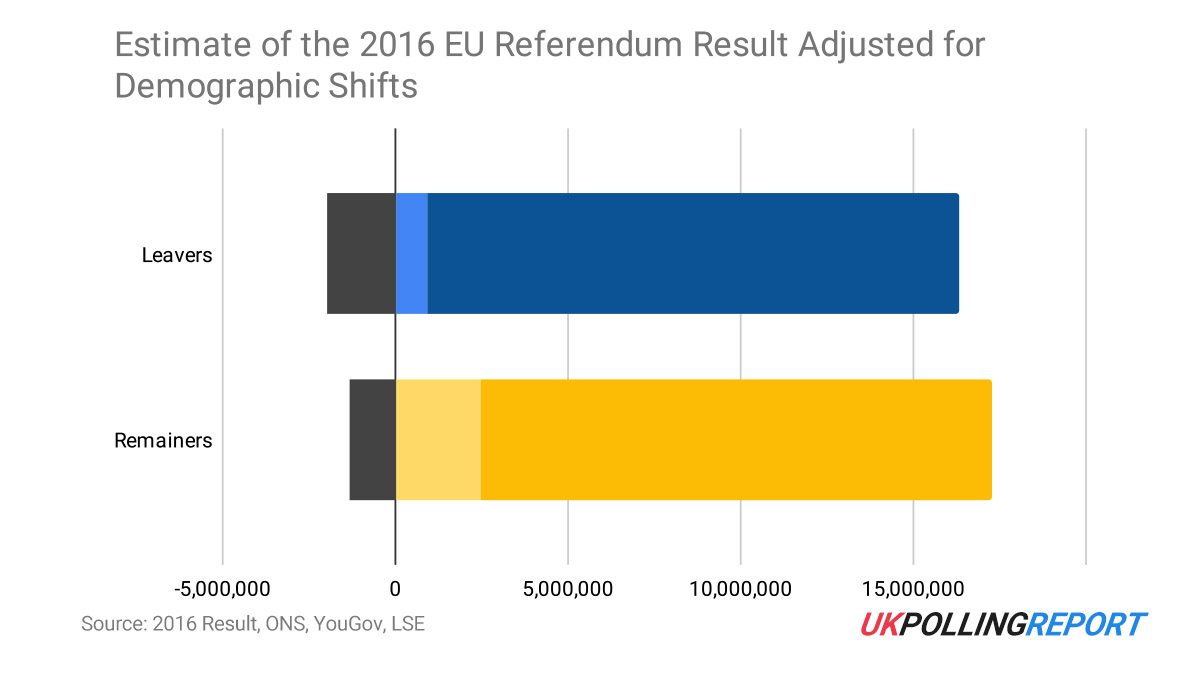
Now of course this exercise is almost entirely academic. Public opinion on Brexit has not remained the same since 2016, age-based turnout and vote share may be subject to error, and it assumes an individual's views don't shift over time. What it does suggest is that broader demographic trends could explain a marginal shift in polling, especially over the long-term. This electorate would put Leave at 49.5% of the vote, compared to 50.5% for Remain. Although this alone is insufficient to explain the recent shift towards Brexit regret, it can provide helpful context.
Although polls have been wrong on Brexit before, there does seem to be a growing sense of concern over the issue. As stories surface of the Conservatives looking into a reappraisal of EU relations, it will be interesting to see how the issue develops. We may well see the re-emergence of dividing lines which had begun to settle.