Sturgeon Still Scotland's Most Popular Politician Despite 12% Margin Against Independence
A recent finding from Panelbase, that 40% of Scottish voters wanted Nicola Sturgeon to resign, made headlines in the national press this weekend. Even though more voters in the same poll, 45%, wanted Sturgeon to stay. The Times also reported Kate Forbes, on 7%, was "the most popular choice" to replace the First Minister - despite the fact 69% said "don't know". Irrespective of the merit of these headlines, and related reporting, new polling from Lord Ashcroft does provide important perspective on discussions around Sturgeon's standings in public opinion.
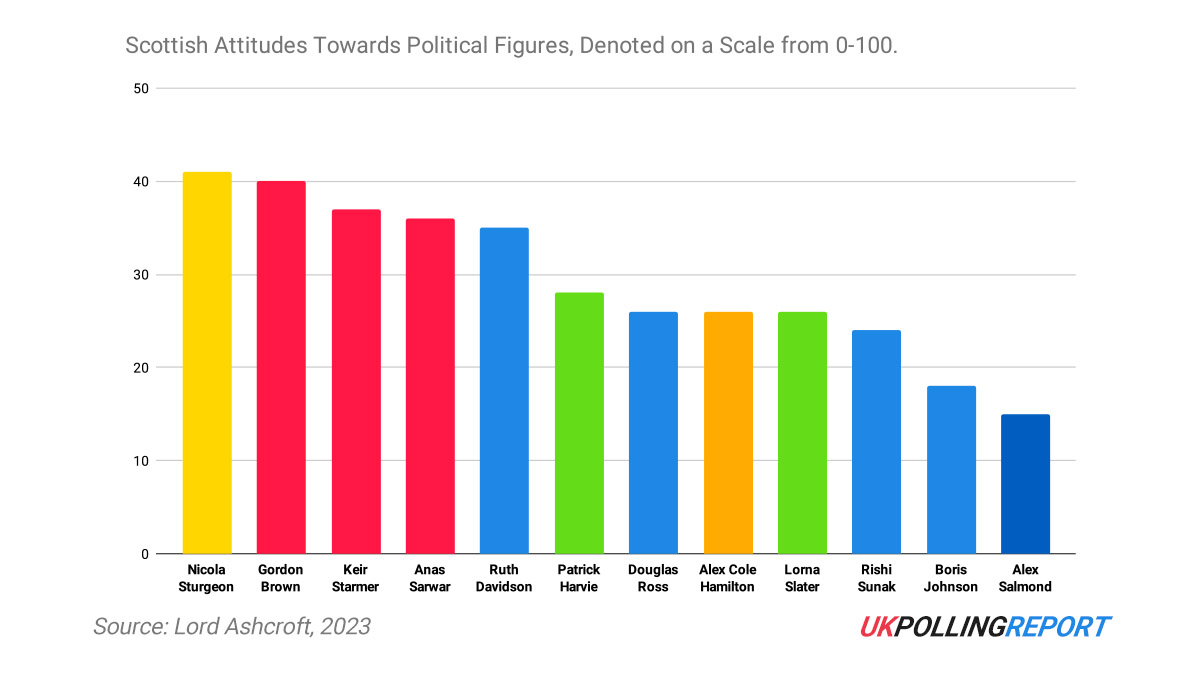
When attitudes towards political figures are quantified on a scale of 0-100, with 0 representing a response of "very negative indeed" and 100 denoting very positive, Nicola Sturgeon tops the list.
She beats out Gordon Brown in second, followed by Keir Starmer, Anas Sarwar and then Ruth Davidson. Whilst it's worth saying that none of the figures had a net positive response rate, it clearly shows Sturgeon's longstanding appeal and recognition hasn't worn off to the extent some might suggest.
Although this might be a positive finding for Sturgeon, elsewhere Ashcroft's poll didn't make easy reading for the SNP. On the topic of independence, it found a 12% margin in support of a "No" vote. It also provided some evidence that most Scottish voters would oppose a strategy of framing the next general election as a 'de facto' independence referendum.
The poll also finds a majority of Scots oppose the Gender Reform Bill. Though looking closer into the findings reveals some important context to the relevance of this. Just 3% of voters count "gender recognition and trans rights" amongst the top 3 issues facing Scotland - it's 15th out of 19 issues listed. And this is after months of protracted debate on the subject. It certainly seems dubious that the issue in itself is a key determinant of independence preferences.
Where the issue may be more relevant, as pointed out by Lord Ashcroft in his write-up, is in how it influences perceptions of the Scottish Government. Voters think the NHS and the economy are the top issues facing Scotland, and yet they perceive the SNP's top focuses to be securing independence and gender recognition reform - a protracted focus on the topic could risk painting the party as out of touch. This logic is hardly confined to Scotland, which might underline why Isaac Levido was so keen to focus on salient issues in Rishi Sunak's five pledges.